Rennie admits All Blacks must fix training loads after five or six calf injuries hit 2026 squad
All Blacks head coach Dave Rennie has acknowledged New Zealand's mounting calf injury problem, revealing the coaching staff are reviewing player loading after Samisoni Taukei'aho, Patrick Tuipulotu, Jordie Barrett, and Richie Mo'unga all missed time this season.
2 min read
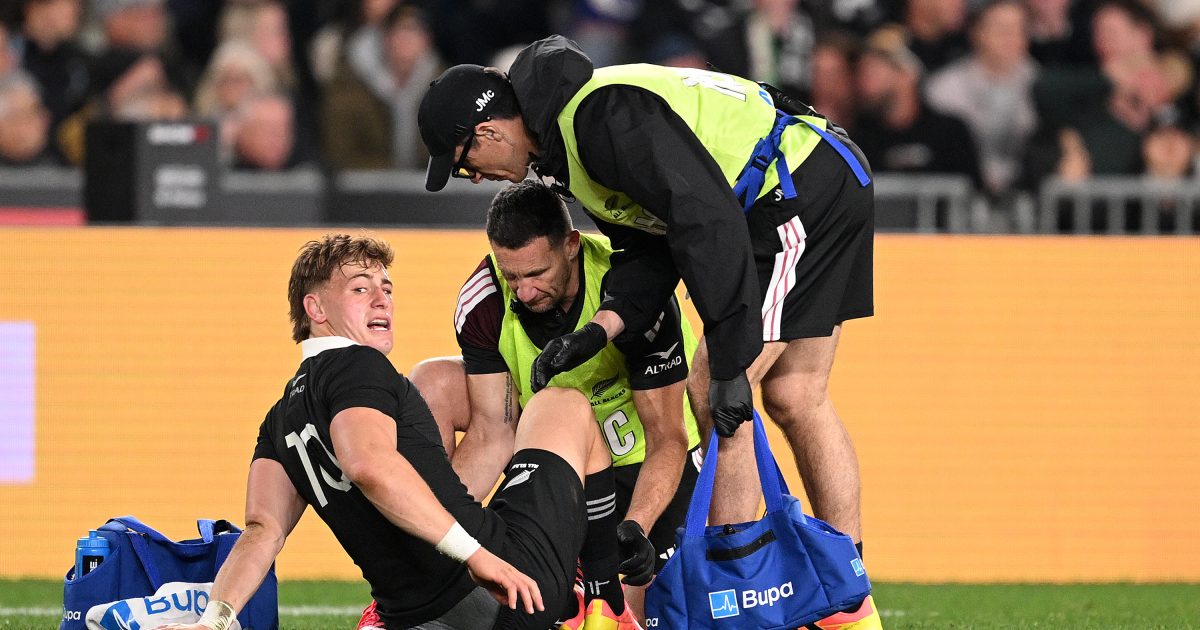
All Blacks head coach Dave Rennie has admitted his coaching staff are actively reviewing training loads after five or six calf injuries disrupted New Zealand’s 2026 international season, with Samisoni Taukei’aho, Patrick Tuipulotu, Jordie Barrett, and Richie Mo’unga all sidelined at various points.
Speaking to media at the All Blacks’ Auckland hotel on Tuesday, Rennie confirmed that Tuipulotu has only recently returned to running and has yet to complete any contact work following the gruelling eight-week tour of South Africa — ruling him out of contention for the Nations Championship finals. Taukei’aho faces a longer absence, having been ruled out for the remainder of the 2026 international season after sustaining his calf injury while defending a Wallabies rolling maul.
Rennie was careful to distinguish between the calf problems and the collision-based injuries that have also affected the squad. “A lot of the collision-type injuries you can’t do much about,” he said, pointing to shoulder injuries sustained by Ardie Savea, Billy Proctor, and Caleb Clarke as examples of unavoidable contact damage.
The calf cluster, however, prompted a closer look at how players are managed when they return to the All Blacks environment after time away. “We had a few calves over the last couple of weeks, and so we’ve looked carefully at our loading for guys who are away from us for a couple of weeks, and then coming back in,” Rennie said.
GPS data collected from players during their time away from the squad gave the coaching staff a detailed picture of the workloads involved. Rennie said the players had followed their prescribed programmes correctly, suggesting the issue may lie in how those programmes connect with the demands placed on them once back in camp.
“All the guys who are away from us had GPS, so we got an idea of exactly the sort of programs they’re supposed to do, and the boys nailed those programs,” he said. “We just got to make sure that we get our loading right too. So not all necessarily just dealt to us — we’re just trying to work out why we had five or six calves.”
Rennie was clear that the solution will not involve reducing training intensity. “We need to train at an intensity and play at the intensity we want to play it, so we’re just looking carefully at that,” he said, framing the challenge as one of precise load management rather than a softening of standards.
Read also
-
 Rugby ·
Brad Mooar names eight debutants in first Fijian Drua Super Rugby squad
-
 Rugby ·
Seattle Seawolves re-sign Coetzer as South Africa-born fly-half targets 2027 USA World Cup place
-
 Rugby ·
Janse van Rensburg stood down indefinitely as Fin Smith battles to face Australia
-
 Rugby ·
Sanderson backs Lawes to force England recall and fulfil 2027 World Cup dream
-
 Rugby ·
Uncapped Macs Page earns Wales call-up after Rio Dyer's hamstring rules him out
-
 Rugby ·
Kelter warns Eagles not to underestimate 'wounded' Red Roses as USA chase historic sixth win