Honda's turbo lag returns to haunt Alonso and Aston Martin despite Singapore upgrade
Fernando Alonso flagged driveability issues at the Marina Bay Street Circuit after Honda's second power unit upgrade failed to cure persistent turbo lag. Honda's chief trackside engineer Shintaro Orihara confirmed the problem resurfaced due to Singapore's energy-rich conditions.
2 min read
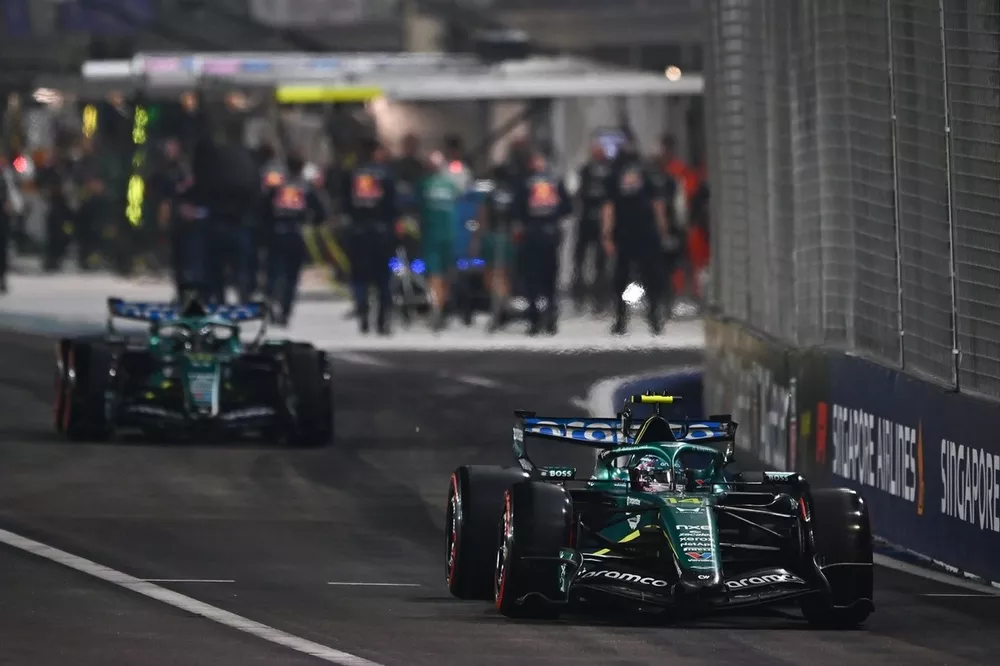
Fernando Alonso and Aston Martin left Singapore frustrated after Honda’s second ADUO power unit upgrade of the season failed to resolve a recurring turbo lag problem at the Marina Bay Street Circuit, with Honda chief trackside engineer Shintaro Orihara confirming the issue had unexpectedly returned.
The setback was particularly jarring given Aston Martin’s strong showing in Malaysia the previous weekend. Singapore, with its low-speed corners and heavy braking zones, looked well-suited to the AMR26 on paper, but the car’s driveability fell short of expectations across the race weekend.
Honda had already identified turbo lag — the delay between a driver pressing the accelerator and the turbocharger fully spooling up — as a key weakness when it introduced a new power unit specification at Zandvoort. To address it, the Japanese manufacturer spent one of its two permitted ADUO tokens for the season on a new turbocharger, introduced at the Madrid Grand Prix. Post-race checks in Singapore found no specific hardware fault, pointing instead to the same underlying issue.
“Even though we introduced a new turbocharger to manage turbo lag, we still struggled to manage that lag in Singapore because of the unique track layout and also the energy-rich situation,” Orihara said. “That has given some unstable acceleration to the driver.”
Orihara explained that the MGU-K — the motor-generator unit on the kinetic side of the hybrid system — can partially offset turbo lag by allowing the combustion engine to operate at a higher load point during off-throttle phases. However, that strategy depends on the system having sufficient harvested energy available, and Singapore’s energy-rich circuit characteristics made adequate harvesting difficult to achieve.
“If we go to energy-rich circuits, sometimes it’s difficult to get enough MGU-K harvesting value because of the energy-rich situation,” he said. “In that case, the operation mode of the engine is not enough to control turbo lag and that’s why we struggled at Singapore.”
Honda sent both engineers and power units back to its Sakura facility for deeper investigation following the race. The fact that no hardware fault was identified suggests the challenge is primarily one of calibration and energy management strategy rather than a mechanical defect — but with the championship calendar moving on, time to find a solution is limited. The problem is likely to resurface at any future circuit that places similarly high energy demands on the power unit.
Read also
-
 Formula 1 ·
Hadjar's Austin practice unravels as front tyres die in sector one of FP2
-
 Formula 1 ·
Verstappen ends Austin Friday second as Red Bull targets low-speed deficit
-
 Formula 1 ·
Antonelli within 0.042s of FP2 lead as Mercedes finds rhythm with upgraded W17 in Austin
-
 Formula 1 ·
McLaren's final 2026 upgrades target suspension and aero as MCL40 struggles persist
-
 Formula 1 ·
Horner says he could walk away from F1 for good after Red Bull sacking
-
 Formula 1 ·
Antonelli rookie card fetches $878,400 as 20-year-old closes in on F1 title