Mercedes debuts serrated diffuser edge at Canadian GP that no rival has tried
Mercedes brought its most significant upgrade package of the 2025 season to Montreal, headlined by a novel diffuser design featuring a serrated upper edge and a new flow deflector on the waterfall section — solutions not seen on any other car on the grid.
2 min read
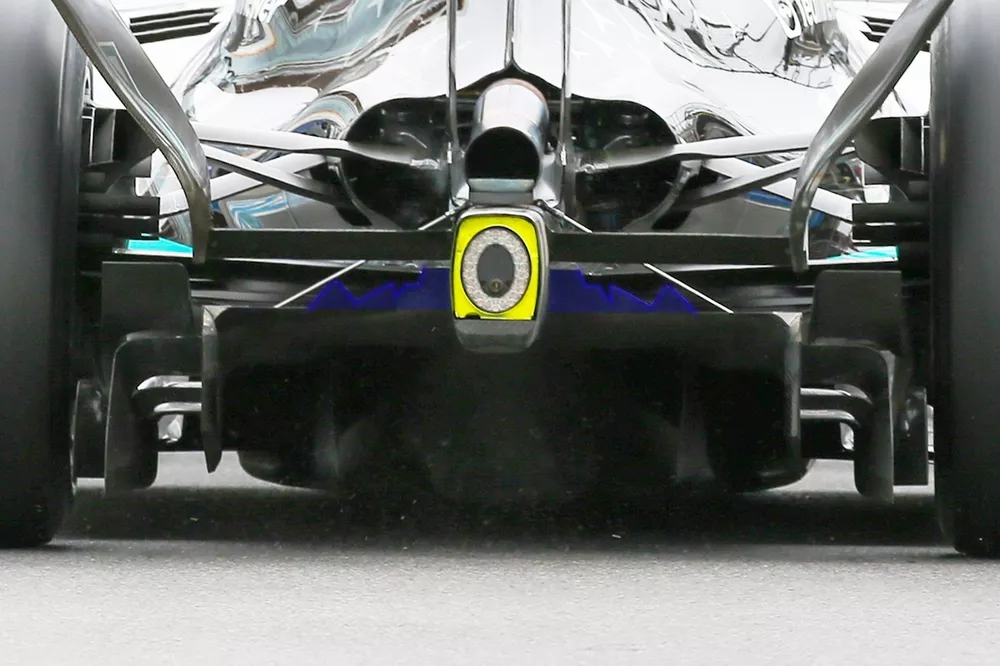
Mercedes introduced a genuinely distinctive rear-end aerodynamic solution at the Canadian Grand Prix in Montreal, debuting a diffuser design that sets the W17 apart from every other car on the Formula 1 grid. The serrated upper edge and a new outward-facing flow deflector on the waterfall section are the headline elements of what the Brackley team described as its first truly significant upgrade package of the season.
The update touched several areas of the car. The front wing was revised almost entirely while retaining a broadly similar philosophy to the previous specification, and engineers also devoted considerable attention to the bargeboards and the floor. The region ahead of the rear tyres has become notably more complex — a sensitive zone where teams work to counteract the disruptive aerodynamic effects caused by tyre rotation.
The most striking novelty, however, sits at the diffuser itself. Since pre-season testing, teams across the paddock have been attaching extensions to the rear crash structure to push the diffuser’s influence as far as the regulations allow, with some integrating the horizontal rear-wing support into those extensions. Mercedes has taken a different path entirely.
Rather than following the conventional extension approach, the Brackley engineers have added serrated profiles along the upper section of the diffuser, covering more than half of its width. The concept is conceptually similar to the serrated elements some teams use on the transparent screen ahead of the cockpit, but applied here to manage airflow exiting the floor at the rear. No other team has been observed running this configuration.
Alongside the serrated edge, a small outward-facing flow deflector has appeared on the waterfall profiles beside the diffuser — visible as a highlighted element in technical photographs from the circuit. Its purpose is to fine-tune how air leaves the floor in that transitional zone between the diffuser and the lateral waterfall section.
Ferrari has previously experimented with modifications to the outermost lower area of the diffuser where it meets the waterfall, but Mercedes has chosen to work on the upper section instead, adding the deflector to the highest element of the waterfall. Whether the approach delivers a meaningful performance gain — and whether rivals move to replicate it — will become clearer over the coming rounds.
Read also
-
 Formula 1 ·
F1 Academy champion Doriane Pin urges young girls to 'dare to believe' in motorsport dreams
-
 Formula 1 ·
Formula 1 brings full 2026 grid to Hot Wheels Infinite Rush in first-ever F1 gaming crossover
-
Formula 1 ·
F1 Commission cuts 2027 race distances by 15km to manage new power unit fuel demands
-
 Formula 1 ·
Sainz urges Williams karting prodigy Will Green to embrace risk in single-seater step
-
 Formula 1 ·
Steiner predicts Verstappen will go winless in 2026 as Red Bull struggles persist
-
 Formula 1 ·
F1 Academy champion Doriane Pin targets Mercedes race seat within five years

 Italy U20 W