Leclerc reveals how taming his aggressive style unlocked his Silverstone victory
Charles Leclerc says adapting his naturally aggressive driving style to the demands of the 2026 Formula 1 regulations has been his biggest challenge this season. A series of adjustments made ahead of the British Grand Prix ultimately delivered his first win of the year.
2 min read
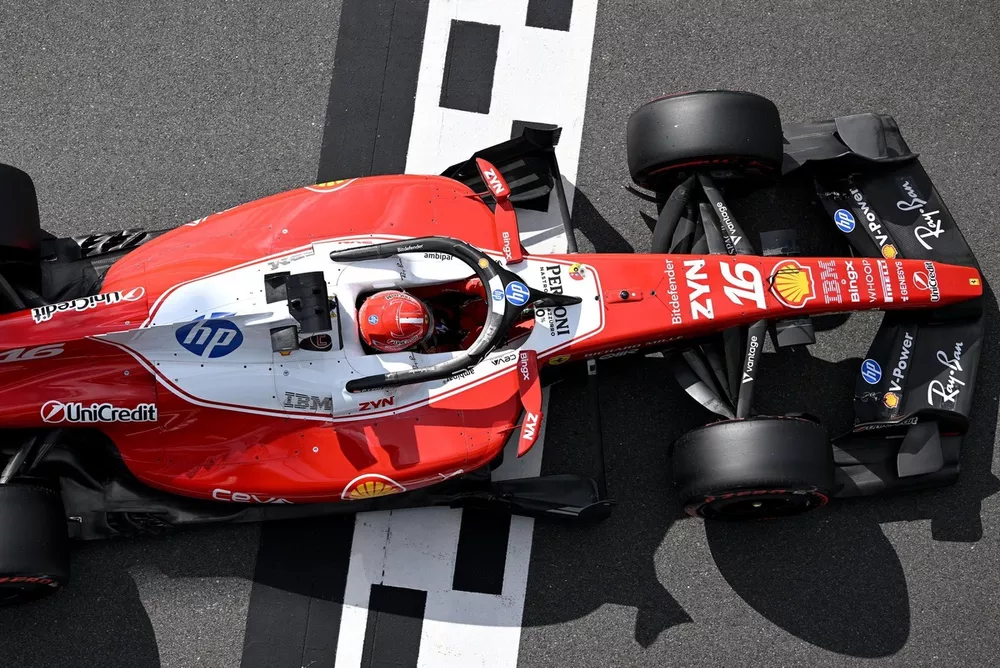
Charles Leclerc has identified the tension between his instinctive driving style and the specific demands of the 2026 Formula 1 cars as the defining challenge of his season so far — one he believes he began to solve at Silverstone, where he claimed his first grand prix victory since 2024.
The Ferrari driver made a series of deliberate changes to his approach across the British Grand Prix weekend, finding a way to extract the best from the SF-26 without falling into the performance traps the new regulations have set for aggressive drivers. The win drew him level with team-mate Lewis Hamilton on one victory apiece through the opening third of the season.
“I’ve got quite an aggressive driving style in general,” Leclerc said. “I think that has been a strength during my career. But then with these cars, sometimes you’ve got to be careful not going the other side because then the dip is quite big.”
The 2026 regulations have reshaped the driving experience significantly. Sweeping changes to both powertrain and chassis rules have reduced downforce levels and made energy management a central part of performance. Leclerc explained that an overly aggressive throttle application now carries a steep cost, disrupting braking references and compounding into a cycle of constant re-adaptation.
“You can start losing quite a lot of performance power unit-wise if you are not efficient, if you don’t go on the throttle in a clean way,” he said. “Then it starts becoming a bit tricky because you get into very different issues where your speed into the next corner is different and that changes your braking point — and you are always re-adapting your references and it makes it very, very difficult.”
Leclerc was also careful to frame his early-season struggles as a product of the wider regulatory shift rather than any particular mismatch between himself and the Ferrari. He noted that Hamilton’s slightly stronger points tally reflected the new generation of cars suiting a more measured approach, not the SF-26 being inherently better suited to his team-mate.
“I don’t think it’s with the Ferrari itself,” he said. “I think it’s more with this generation of cars.”
Despite the Silverstone breakthrough, Leclerc was measured in his assessment of what one win means. He said he had identified “a detail” in sprint session data that offered a clearer picture of his struggles, and stressed that sustaining the feeling he found in Britain across multiple circuits remains the real test.
“This is something I want to prove on multiple racetracks,” he said. “I’m very happy with the race win, but it’s not only with one race win that now everything is fine and I’m relaxed. If the feeling is there, then it’s always been the case that when I feel good with a car, normally the lap times and the performance comes.”
Read also
-
 Formula 1 ·
Albon reveals Monaco's F1 bubble as Williams driver endures tough 2025 season
-
 Formula 1 ·
Steiner slams FIA president's offer to help Aston Martin keep Alonso competitive
-
 Formula 1 ·
Verstappen rules out comeback as Antonelli closes in on youngest-ever F1 title
-
 Formula 1 ·
Vowles admits Williams upgrades won't rescue team from 2026 F1 struggles
-
 Formula 1 ·
Mercedes' secret weekly codes helped Antonelli nail his race-winning VSC pitstop in Madrid
-
 Formula 1 ·
Rosberg warns Antonelli could grow 'panicked' if McLaren and Ferrari close the gap