McLaren cannot explain why it loses 1.5 tenths to Mercedes on straights despite sharing the same engine
McLaren team principal Andrea Stella has revealed the MCL40 is losing around 1.5 tenths per lap to Mercedes on the straights, despite both cars running the same Mercedes power unit. The team suspects excess aerodynamic drag or a difference in how the two outfits operate the shared powertrain.
2 min read
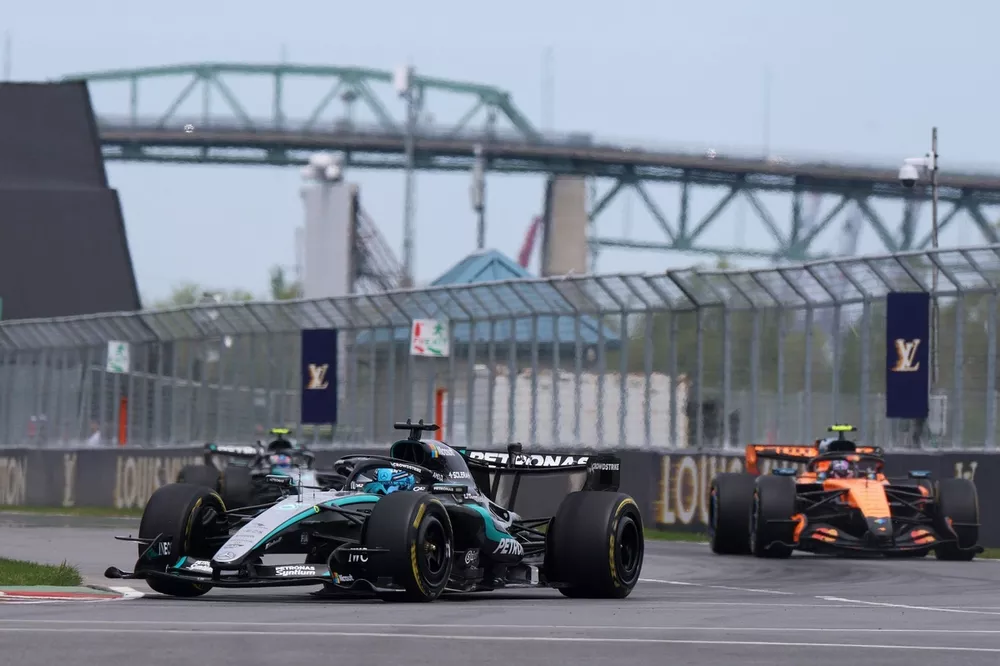
McLaren team principal Andrea Stella has admitted the team does not yet know why the MCL40 is surrendering roughly 1.5 tenths per lap to the championship-leading Mercedes W17 on the straights, despite both cars being powered by the same Mercedes unit.
Speaking in Austria, Stella estimated the overall gap between the two cars at three to four tenths per lap, breaking it down as approximately 70% lost in the corners and 30% on the straights. The corner deficit has a straightforward explanation — the W17 generates more downforce than the MCL40 — but the straight-line shortfall is less clear-cut.
“The 30% happening in the straights, it might have to do with some additional aerodynamic drag that we have on our car, but we are also looking at the way we exploit the power unit, because the speed deficit is quite significant,” Stella said.
Two theories are currently on the table. The first is that the McLaren carries more drag, limiting its acceleration and top speed relative to the Mercedes. The second is that the two teams are operating their shared Mercedes powertrain differently, with Mercedes’ High Performance Powertrains (HPP) division having a natural head start in optimising its own engine.
Stella was careful to stress that the relationship with HPP remains constructive, and that the supplier is actively helping McLaren unlock further gains in energy deployment. Nevertheless, he acknowledged the problem is difficult to reverse-engineer precisely because the two potential causes are hard to separate.
His proposed method for isolating the issue is blunt but logical: reduce the MCL40’s aerodynamic drag and check whether a straight-line gap to Mercedes still exists. If it does, the team will know the powertrain operation is also a factor.
“I don’t know if you have access to the GPS overlays, but I think nowadays that’s a really interesting source of information to see the characteristics of the various cars,” Stella added. “You will be able to see that there’s probably one-and-a-half tenths, one tenth at least, that we lose in the straights, and definitely we need to go and look into why that is the case.”
McLaren has already flagged upcoming aerodynamic upgrades designed to close the downforce gap to Mercedes, which Stella described as “good projects that will land trackside”. Whether those same updates also trim drag — and in doing so shed light on the straight-line mystery — will be closely watched as the season progresses.
Read also
-
 Formula 1 ·
Vettel backs F1 2026 rules to unite sustainability and raw excitement after Monza Ferrari run
-
 Formula 1 ·
Steiner warns Madrid must fix Madring layout after processional 2026 Spanish GP
-
 Formula 1 ·
Ex-Ferrari engineer Smedley calls for augmented steward group to end post-race verdicts
-
 Formula 1 ·
Coulthard demands faster FIA safety car calls after Norris loses Spanish GP win
-
 Formula 1 ·
Coulthard praises Russell for admitting Antonelli is outperforming him as title slips away
-
 Formula 1 ·
Racing Bulls rookie Lindblad nearly flips Guinness-record Fiat Panda in off-season YouTube stunt

 Korea DPR U20 W