Honda reveals it secretly used both ADUO tokens, fixing turbo lag from Spain
Honda Racing Corporation president Koji Watanabe has confirmed the company quietly introduced a second ADUO upgrade — a revised turbocharger targeting lag — in Lance Stroll's car at the Spanish Grand Prix, having previously indicated only one token would be used.
2 min read
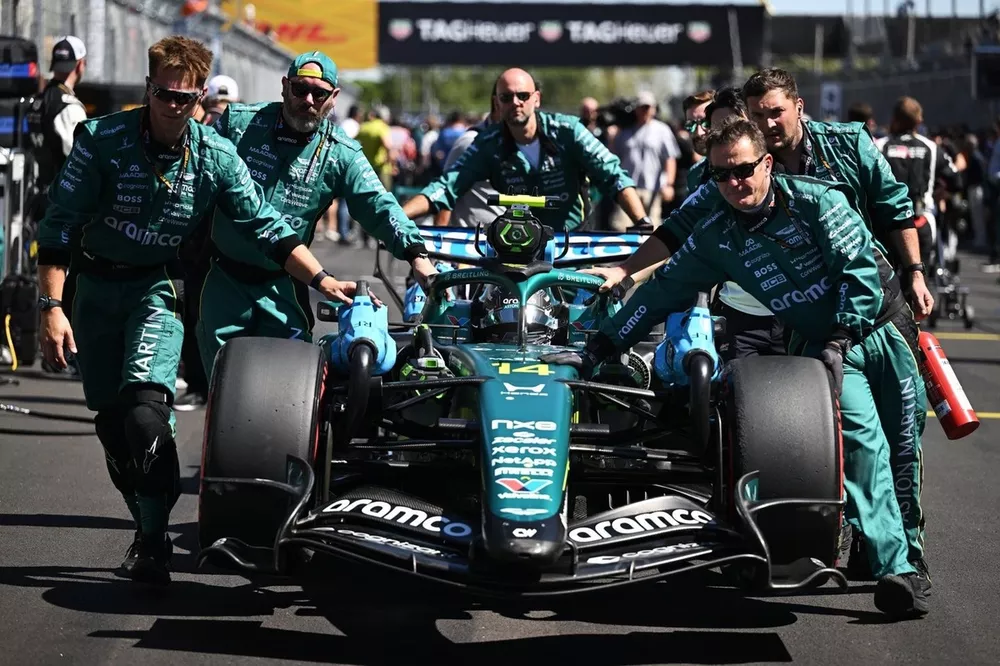
Honda Racing Corporation president Koji Watanabe has confirmed that the Japanese manufacturer deployed both of its permitted ADUO (Additional Development and Upgrade Opportunities) tokens this season, with the second upgrade — a revised turbocharger — introduced as far back as the Spanish Grand Prix in a move that went publicly unannounced at the time.
Watanabe made the disclosure when asked by Motorsport.com why Honda had appeared to use only one ADUO allocation. “We used both of them,” he said. “We introduced the first ADUO upgrade in the Netherlands, and then we put a PU incorporating the second update into Lance Stroll’s car at the Spanish Grand Prix.”
The first upgrade, a revised internal combustion engine spec, was fitted to both Aston Martin cars at Zandvoort. However, Watanabe acknowledged it brought complications. “The Spec 2 PU we introduced in the Netherlands had some drivability issues, so we introduced an improved turbo at the Spanish Grand Prix,” he explained. When asked whether the specific objective was to address turbo lag, his answer was direct: “Yes.”
The FIA’s published power unit component usage data supports the timeline. Stroll’s car was recorded as running its fifth turbocharger of the season at the Spanish GP, while Fernando Alonso’s car received what appears to be the same upgraded component at the Azerbaijan Grand Prix.
Honda was granted permission to use two ADUO tokens after its ICE was measured at more than four percent below the output of the Red Bull Ford Powertrains engine, which was rated as producing the highest power of any unit on the grid. The ADUO framework exists specifically to allow manufacturers running significantly underpowered units to close the gap within a season.
Watanabe explained that the staggered deployment was driven by development timelines rather than strategy. “It would have been better if we could have introduced everything at once, but it was important to introduce Spec 2 in the Netherlands first. We were also working on measures to address the turbo lag in parallel, so we introduced that in Spain. So the application ended up being split between the two.”
Despite the upgrades, Watanabe cautioned that Honda has not yet unlocked the full potential of its power unit. He drew a parallel with the manufacturer’s previous Red Bull partnership, during which performance upgrades were prohibited but Honda continued using simulations to incrementally raise the PU’s operating limits — a process it called “reliability development.” That approach ultimately enabled Red Bull to run extremely compact cooling packaging in 2024, and Watanabe suggested similar headroom still exists in the current Aston Martin-spec unit.
Read also
-
 Formula 1 ·
Toyota rules out Ocon WEC move to protect its long-standing driver culture
-
 Formula 1 ·
Steiner dismisses Horner-Vasseur Ferrari pairing as book publicity stunt
-
 Formula 1 ·
Antonelli 'spooked himself' in Baku as 66-point F1 lead narrows, warns Schiff
-
 Formula 1 ·
Russell leads seven F1 drivers on Langkawi getaway before Bahrain Grand Prix
-
 Formula 1 ·
Brundle warns McLaren's Azerbaijan upgrade could be heading for the bin after structural cracks emerge
-
 Formula 1 ·
Wolff admits Mercedes face tougher strategy calls as Russell closes on Antonelli

 Venezuela U17