Hadjar feared a 'very long year' before Red Bull's own engine stunned the F1 field
Isack Hadjar has revealed his first impression of Red Bull's in-house power unit was deeply pessimistic — yet the engine has since been ranked best in class by the FIA, with the team claiming its first win of the 2026 season in Malaysia.
2 min read
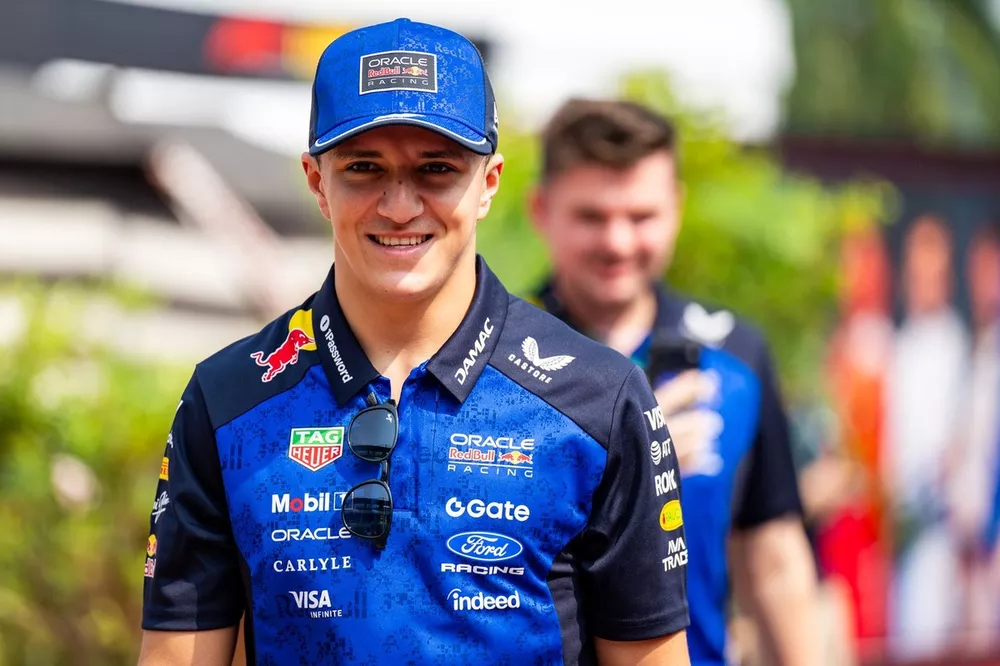
Isack Hadjar admitted his initial reaction to Red Bull’s homegrown Formula 1 engine after his first lap in Barcelona was one of dread — a stark contrast to the unit’s current status as the FIA’s top-ranked internal combustion engine on the 2026 grid.
Red Bull’s victory in Malaysia marked not only the team’s first win of the 2026 season but the first triumph powered by a Red Bull Ford Powertrains unit — a project that, as former team principal Christian Horner noted, was still “a hole in the ground” just five years ago. Horner, alongside Helmut Marko and the late Dietrich Mateschitz, has been credited with driving the initiative that has since caught the entire paddock off guard.
Hadjar’s early pessimism has given way to genuine surprise. The Frenchman recalled that after his first representative lap with the new power unit, he believed it was going to be a difficult season. The subsequent trajectory — competitive showings in Baku and Malaysia, and the FIA’s ranking — tells a very different story.
Max Verstappen, by contrast, said he deliberately avoided forming strong expectations in either direction heading into 2026. “I would say that I was very neutral in that. I was not trying to be super optimistic, but also not negative, because, I mean, how would you know?” the four-time world champion told Motorsport.com.
“You trust that the people who have been hired, that they’re doing a good job. They have the facilities to deliver a very good engine because Red Bull invested a lot of money in that. I was not too stressed about it, but of course we are very happy now with how we started.”
Verstappen also took a pointed dig at the struggles facing Honda — Red Bull’s previous engine supplier — elsewhere in the paddock. “It could have been much worse as we can see in other places,” he said, before adding that the team’s internal drive remains undiminished: “We’re proud that we’re still working hard, because we know there are a lot of areas where we want to do better.”
The FIA’s decision to rank Red Bull’s internal combustion engine as the strongest in the field has come at a cost: the team is now the only manufacturer ineligible for an ADUO development token, meaning hardware improvements are off the table for now. However, Red Bull and Ford have continued to extract performance through iterative software updates and refined energy management strategies, developments that team principal Laurent Mekies and his engineers have deployed race by race since the season began.
The arc from Hadjar’s gloomy first impression in pre-season testing to a race win in Kuala Lumpur encapsulates just how comprehensively Red Bull’s in-house engine programme has exceeded expectations — including those of the drivers who had to trust it from day one.
Read also
-
 Formula 1 ·
Leclerc admits Ferrari's 2026 software punishes his aggressive qualifying instincts
-
 Formula 1 ·
Hadjar says cooling vests should be banned as F1 drivers remain split ahead of Singapore
-
 Formula 1 ·
Russell admits his own form is failing him, not just Mercedes' reliability
-
 Formula 1 ·
Russell leads Singapore FP1 on softs as Verstappen dominates medium-tyre running
-
 Formula 1 ·
Russell tops Singapore FP1 but Verstappen's medium-tyre pace raises eyebrows
-
 Formula 1 ·
Piastri warns Red Bull have joined Mercedes as the class of F1 2026

 Belarus W