Formula 1 cuts emissions by 35% since 2018 as net-zero 2030 target stays on track
Formula 1 has reduced its carbon emissions by 35% compared to its 2018 baseline, with a 12% year-on-year drop in 2025 bringing total output to 148,805 tCO2e. The championship remains on course to halve emissions by 2030 before offsetting the rest.
2 min read
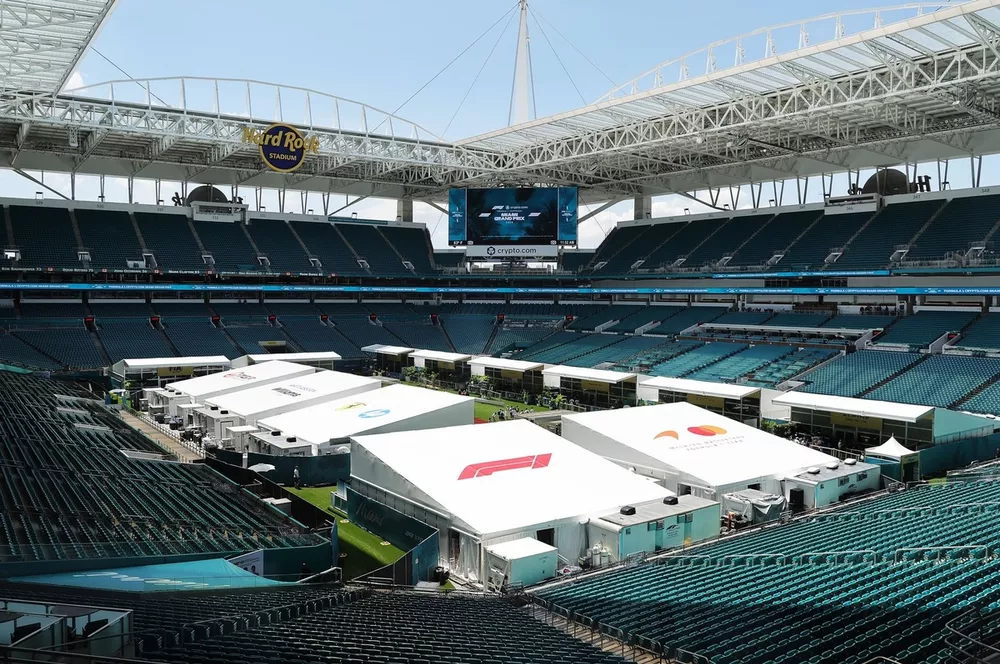
Formula 1 has cut its carbon emissions by 35% since its 2018 baseline, the championship announced in its latest sustainability report, with a verified 11.8% year-on-year reduction in 2025 keeping its net-zero target firmly within reach.
The series emitted 148,805 tonnes of carbon dioxide equivalent (tCO2e) across its factory operations, race venues, and travel in 2025, down from 168,720 tCO2e in 2024. Against the 2018 baseline of 228,793 tCO2e, F1 must halve its total output by 2030 to meet its self-imposed net-zero commitment, with any remaining unavoidable emissions to be addressed through what the championship describes as an “offset using credible programme”. The figures were independently verified by carbon accounting firm Normative.
The largest gains came from F1’s factories and team facilities, where a transition to renewable energy sources has delivered meaningful reductions. On the road, more teams have switched their truck fleets to HVO100 biofuel, while Mercedes has deployed the all-electric Mercedes-Benz eActros 600 for the 2026 European season. F1 has also doubled its investment in sustainable aviation fuel (SAF) and made its first investment in sustainable maritime fuel to reduce the environmental cost of sea freight.
Following a trial at the 2023 Austrian Grand Prix, renewable energy — combining solar power and hydrotreated vegetable oil — is now used at all European races for paddock operations.
Looking ahead, Formula 1’s Future Race Operations Programme aims to base more equipment in regional hubs rather than flying it back and forth from the UK. The championship expects to remove 50% of its current broadcast and related freight from air transport by 2030. Scheduling efficiencies are also being pursued: twinning the Montreal and Miami races from 2026 onwards is expected to generate further savings.
“Sustainability underpins every decision we make,” said Ellen Jones, Head of ESG at Formula 1. “By doubling the sport’s investment in sustainable aviation fuel, making our first investment in sustainable maritime fuel, and continuing to work closely with promoters, teams and partners, we are driving further emissions reductions while accelerating the adoption of the latest technologies.”
With four years remaining before the 2030 deadline, F1 needs to reduce its annual emissions by a further 15 percentage points from the 2018 baseline — a target that its current trajectory suggests is achievable, though the challenge of sustaining reductions across an expanding 24-race calendar remains significant.
Read also
-
 Formula 1 ·
F1 Academy champion Doriane Pin targets Mercedes race seat within five years
-
 Formula 1 ·
Bortoleto reveals Alonso is just as sarcastic and straightforward off camera as on it
-
 Formula 1 ·
Szafnauer warns Cadillac's split US-UK base will cost them a world championship
-
 Formula 1 ·
F1 champion Norris completes 38-lap hypercar test at Portimao in McLaren's MCL-HY
-
 Formula 1 ·
Mercedes staff edge Aston Martin 3-1 in annual charity football match as F1 rivals raise funds off-track
-
 Formula 1 ·
Red Bull confirms Verstappen's car degradation problem won't be fully solved until 2027

 Dominica