FIA's five-second pre-start procedure set to stay in F1 despite safety concerns being resolved
The FIA's Nikolas Tombazis has confirmed that Formula 1's five-second pre-start procedure is likely to remain through the 2027 regulation cycle, even though the original safety concerns that prompted its introduction have since been addressed by other means.
2 min read
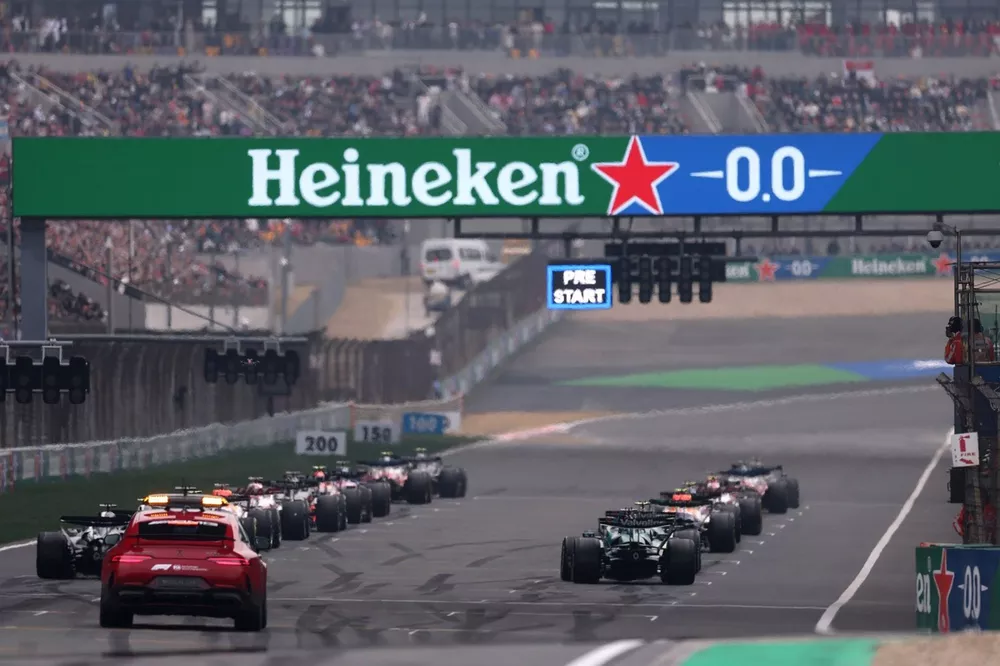
Formula 1’s five-second pre-start procedure is set to remain a permanent fixture on the grid through the 2027 regulation cycle, FIA single-seater director Nikolas Tombazis has confirmed, despite the safety concerns that originally drove its introduction having been resolved separately.
The procedure — a five-second warning period marked by blue flashing lights once all cars have lined up after the formation lap — was introduced following a political dispute that erupted during winter testing in Bahrain. Several teams wanted additional time to spool their turbochargers and build revs before the start lights, but Ferrari resisted, with its smaller turbo unit giving the Scuderia a competitive advantage off the line. The five-second window was the eventual compromise, and Ferrari team principal Frederic Vasseur made clear at the time it was the absolute limit his team would accept: “enough is enough.”
Tombazis told a select group of media that the procedure has now become standard practice regardless of its original rationale. “I think the five seconds are an established process now, I don’t see why it would change in this regulation cycle,” he said. “That does not have to do with safety. It has just to do with having different cars arriving on the grid at different times, and drivers need to be able to prepare in order to have a proper start.”
The more pressing safety work, Tombazis explained, has been carried out on a separate front. Following the season opener in Melbourne — where Liam Lawson pulled away from his grid slot extremely slowly and Franco Colapinto only narrowly avoided a collision — the FIA developed what it describes as a “low power start detection” system. The system identifies when a car accelerates unusually slowly after the driver releases the clutch and automatically triggers MGU-K deployment to guarantee a minimum level of acceleration, reducing the risk of a car stalling on the grid.
“From when we discussed the Miami package in late April until now, we’ve been working on some emergency recovery — electrical parts to help recover a car that has a very slow start and therefore not to risk cars stalling,” Tombazis said.
The distinction Tombazis draws is clear: the pre-start procedure now exists primarily as an operational convenience to standardise grid preparation across a varied field, while the genuine safety net has been embedded in the cars’ electrical systems. Both measures look set to carry into the next regulation era.
Read also
-
 Formula 1 ·
F1's five-second pre-start procedure set to stay through 2027 season
-
 Formula 1 ·
Buxton insists Cadillac 'wouldn't be on the grid' without ousted team principal Lowdon
-
 Formula 1 ·
Wrist injury threatens Hadjar's Dutch GP start with Lawson on standby for Red Bull
-
 Formula 1 ·
Albon signs one-year Williams extension to begin a sixth consecutive F1 season
-
 Formula 1 ·
Steiner confirms he has 'no relationship' with Gene Haas after Haas F1 exit
-
 Formula 1 ·
FIA clears Macarena wing concept but forced Red Bull to prove safety after Verstappen crashes