FIA clears Macarena wing concept but forced Red Bull to prove safety after Verstappen crashes
The FIA has confirmed it will not act against F1's rotating rear wing designs, but required Red Bull to provide additional safety evidence following Max Verstappen's consecutive crashes at Spielberg and Silverstone.
2 min read
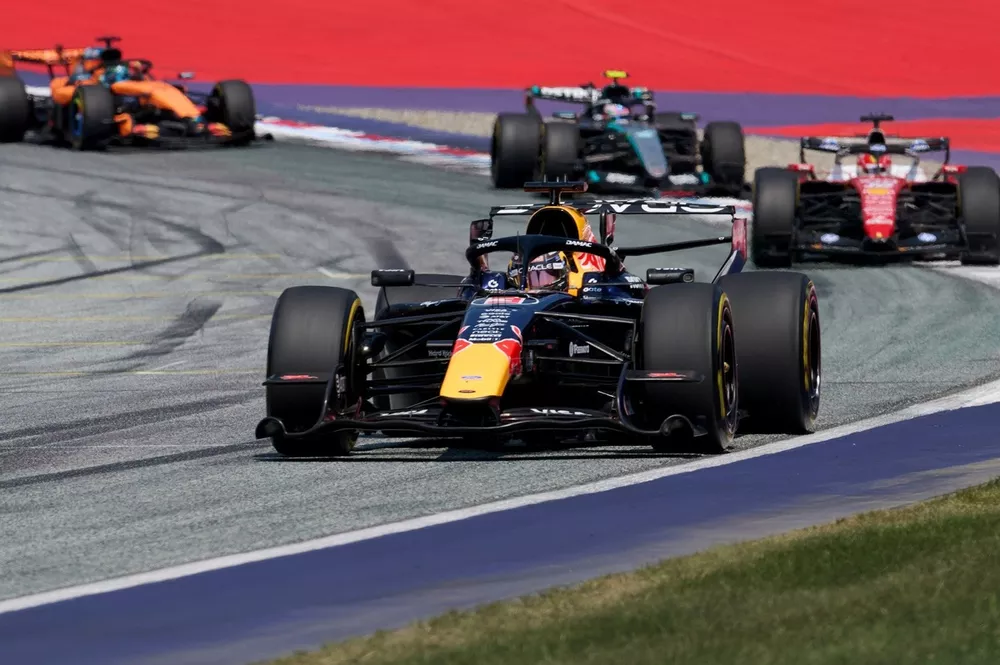
The FIA has given its clearest endorsement yet of Formula 1’s rotating rear wing concept, telling teams it will not intervene against the innovation — but acknowledged it demanded extra safety assurances from Red Bull after Max Verstappen crashed in consecutive races at Spielberg and Silverstone.
FIA single-seater director Nikolas Tombazis confirmed the governing body’s position, stating that its primary concern was ensuring no hydraulic failure could leave a wing locked in the open position at high speed. “We wanted to be sure that there was never a risk of, let’s say, a hydraulic failure, meaning that the wing is staying open and could not come back to a closed position,” Tombazis said.
The so-called Macarena wing — a nickname coined by Ferrari team principal Frédéric Vasseur — first appeared during winter testing, with Ferrari catching several rivals off guard with the concept. McLaren was among those surprised by the innovation when it was unveiled.
Red Bull had been developing its own version independently, with technical director Pierre Wache insisting the team’s design was not inspired by Ferrari’s. The two systems are indeed distinct: Red Bull’s wing rotates in the opposite direction to Ferrari’s. However, Red Bull was unable to get its version race-ready for the season opener, debuting it instead in Miami.
The early race weekends passed without incident for both teams, but scrutiny intensified after Verstappen’s back-to-back crashes. The FIA subsequently requested additional technical information from both Red Bull and Ferrari — a process Tombazis described as symmetrical rather than targeted, since both teams had raced the concept at that stage.
Central to the FIA’s assessment was a failure mode and effects analysis, known as an FMEA, which examined not just the wing’s prescribed closing time but the aerodynamic behaviour of the car in the moments after closure — a period during which airflow does not immediately reattach to the bodywork.
“We went into quite a lot of dialogue to ensure that we felt that these designs were safe,” Tombazis said.
With the FIA now satisfied, the Macarena wing looks set to become a fixture across the grid. McLaren has already tested a rotating wing and is planning to race it at one of the first rounds after the summer break, with other teams understood to be working on their own iterations. The FIA’s decision to permit the concept rather than regulate it away clears the path for the innovation to spread through the field in the second half of the 2026 season.
Read also
-
 Formula 1 ·
Steiner confirms he has 'no relationship' with Gene Haas after Haas F1 exit
-
 Formula 1 ·
Bortoleto earns fan praise for deadpan honesty in Passenger Princess driving episode
-
 Formula 1 ·
Christian Horner launches UK memoir tour after abrupt Red Bull exit
-
 Formula 1 ·
Formula 1 launches 'Five Lights' campaign narrated by Colin Farrell ahead of Dutch GP return
-
 Formula 1 ·
Szafnauer taped 'Netflix' to his forehead to warn staff about Drive to Survive microphones
-
 Formula 1 ·
Tsunoda in talks to swap F1 for IndyCar with Meyer Shank Racing in 2027