Ferrari and Red Bull hold wet-weather testing edge over McLaren ahead of Canadian GP
McLaren team principal Andrea Stella has acknowledged that Ferrari and Red Bull may hold a meaningful advantage at the Canadian Grand Prix in Montreal, after both rivals completed Pirelli wet-weather development running that McLaren did not participate in.
2 min read
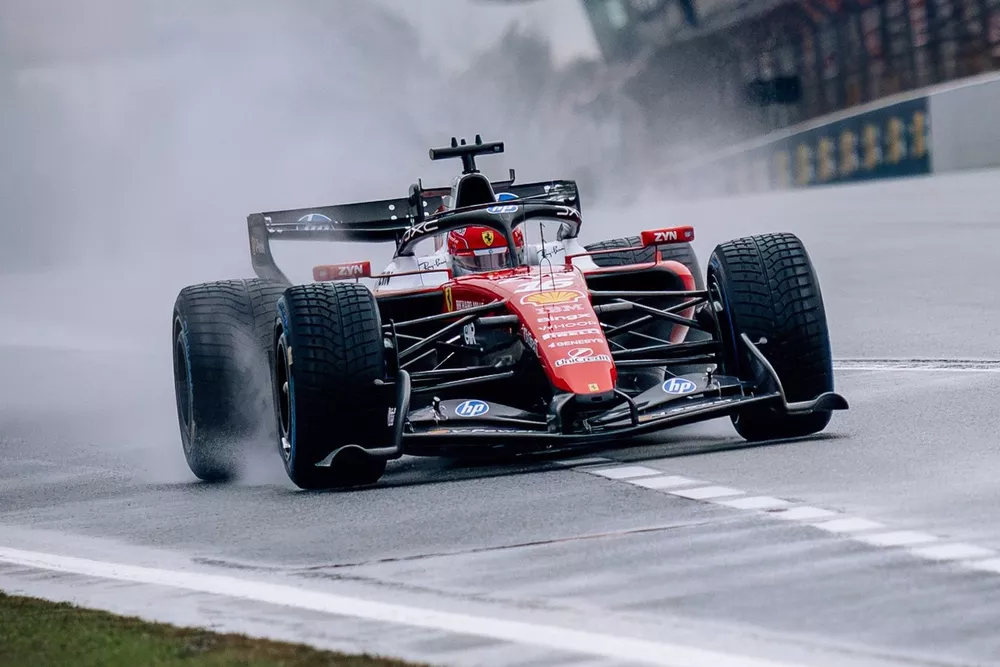
McLaren team principal Andrea Stella has conceded that Ferrari and Red Bull could have a competitive edge in wet conditions at the Canadian Grand Prix in Montreal, having completed Pirelli wet-weather development tests that McLaren skipped earlier in 2026.
Pirelli runs development tests throughout the season, rotating invitations among all teams and sharing the resulting data across the paddock. While teams cannot run upgraded components during these sessions, the running still yields valuable real-world information — particularly in wet conditions, which have not featured in any competitive session so far this year.
Ferrari and Red Bull were the only two teams to run on the wet day during the Barcelona shakedown in early January, a session that included a significant crash for Red Bull’s Isack Hadjar. Further wet mileage followed: Hadjar and Racing Bulls drivers Arvid Lindblad and Liam Lawson tested at Suzuka after the Japanese Grand Prix, Lewis Hamilton completed a wet session at Ferrari’s Fiorano test track in April, and Alpine’s Pierre Gasly ran at Magny-Cours earlier this month.
With rain forecast for race day on Île Notre-Dame and temperatures expected to sit around an unusually cold 12°C, Stella believes that accumulated knowledge of how the power unit and tyres behave in the wet could prove decisive.
“I do think that this is an advantage, because there’s uncertainty in relation to the behaviour of the power unit,” Stella said. “In the wet, things deviate even more from what you anticipate and from what you can simulate. So the power unit remains certainly an element of variability that is concerning. And if you have tested with it, you might have known a little bit more.”
Stella also flagged the particular challenge of generating tyre temperature at the Circuit Gilles Villeneuve, a track he described as one of the smoothest surfaces of the season and one that lacks high-speed corners — the type of corners that typically help drivers build heat into the rubber.
“It’s unclear whether the tyres will work within their window or they will be slightly outside their window,” he added. “And also, it’s not like we have had several sessions in the wet — not at all during a race weekend — for Pirelli to even calibrate as to where they have positioned the compound. So many variables to discover for us that we don’t have much experience on the wet. And a little advantage for those who have tested.”
The combination of a cold, rain-soaked track and a uniquely smooth circuit surface is expected to produce an exceptionally low grip level, making tyre management and power unit mapping among the most critical factors of the weekend.
Read also
-
 Formula 1 ·
F1 Academy champion Doriane Pin urges young girls to 'dare to believe' in motorsport dreams
-
 Formula 1 ·
Formula 1 brings full 2026 grid to Hot Wheels Infinite Rush in first-ever F1 gaming crossover
-
Formula 1 ·
F1 Commission cuts 2027 race distances by 15km to manage new power unit fuel demands
-
 Formula 1 ·
Sainz urges Williams karting prodigy Will Green to embrace risk in single-seater step
-
 Formula 1 ·
Steiner predicts Verstappen will go winless in 2026 as Red Bull struggles persist
-
 Formula 1 ·
F1 Academy champion Doriane Pin targets Mercedes race seat within five years

 Gibraltar