Binotto claims Audi has fourth-best chassis but engine gap won't close until 2028
Audi team principal Mattia Binotto says GPS data and driver feedback from the opening rounds of the 2026 season indicate the R26 has the fourth-best chassis on the grid, placing it behind Ferrari, Mercedes and McLaren — though he acknowledges the power unit remains a significant weakness.
2 min read
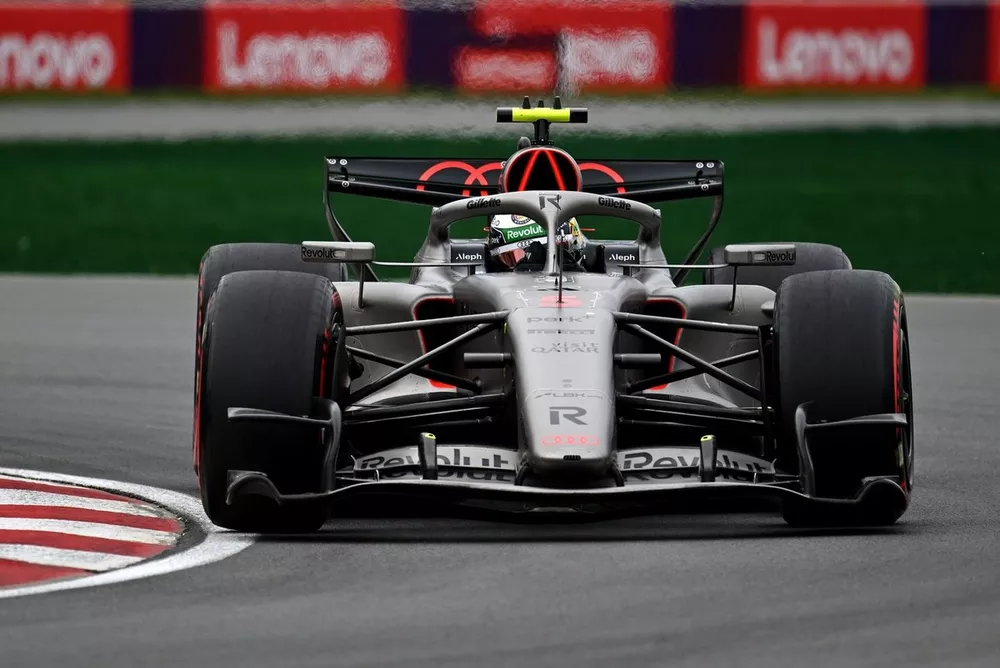
Mattia Binotto believes Audi already possesses the fourth-best chassis in Formula 1 during its debut season as a works outfit, but has conceded that closing the power unit gap to the front-runners is unlikely before 2028. The assessment, based on GPS telemetry analysis and driver feedback from the opening rounds of the 2026 campaign, represents a striking early benchmark for a team that currently sits ninth in the constructors’ standings.
“I’m very pleased by the chassis,” Binotto told the Beyond the Grid podcast. “Even discussing that with drivers, not only GPS telemetry analysis. First, we got a good correlation with the wind tunnel and the simulator. I think our car is pretty fast in the corners. We believe that maybe we’re even the fourth team in terms of chassis, which as an ex-Sauber, it’s an outstanding result.”
In Binotto’s estimation, the three teams ahead of Audi on chassis performance are Ferrari, Mercedes and McLaren. Notably, he credits Red Bull with the second-best power unit despite the Milton Keynes outfit currently sitting further back in the standings — an acknowledgement of how competitive Red Bull Powertrains has been on its first attempt at building an F1 engine.
The power unit picture is considerably less flattering for Audi. The team has suffered reliability problems through the early rounds, with one of its drivers failing to start at both the Australian and Chinese Grands Prix due to technical failures. Nico Hülkenberg’s 11th-place finishes at the Chinese and Japanese events represent the team’s best race results so far.
Binotto has been candid that a meaningful engine improvement in 2027 is unrealistic, framing 2028 as the first credible target for closing the gap — a timeline that aligns with Audi’s eligibility for ADUO concessions available to newer power unit manufacturers. The Italian engineer frames the current situation not as a crisis but as a predictable stage in a structured development roadmap, pointing to the chassis performance as evidence that the underlying engineering processes are sound.
The broader context makes Audi’s chassis achievement more significant than it might appear. The Sauber infrastructure that Audi inherited was not regarded as a top-four operation in recent seasons, meaning the aerodynamic and mechanical gains made during the transition to a full works programme have been substantial. Whether that platform can be maintained as the power unit development accelerates will be the defining challenge of the next two seasons.
Read also
-
 Formula 1 ·
F1 Academy champion Doriane Pin urges young girls to 'dare to believe' in motorsport dreams
-
 Formula 1 ·
Formula 1 brings full 2026 grid to Hot Wheels Infinite Rush in first-ever F1 gaming crossover
-
Formula 1 ·
F1 Commission cuts 2027 race distances by 15km to manage new power unit fuel demands
-
 Formula 1 ·
Sainz urges Williams karting prodigy Will Green to embrace risk in single-seater step
-
 Formula 1 ·
Steiner predicts Verstappen will go winless in 2026 as Red Bull struggles persist
-
 Formula 1 ·
F1 Academy champion Doriane Pin targets Mercedes race seat within five years

 Italy U20 W