Audi open to V8 engines in F1 but insists turbo efficiency must stay central
Audi CEO Gernot Dollner says the German manufacturer has no objection to V8 engines under Formula 1's next regulatory cycle, expected from 2030 or 2031, but stresses that turbocharging and energy efficiency remain non-negotiable priorities for the brand.
2 min read
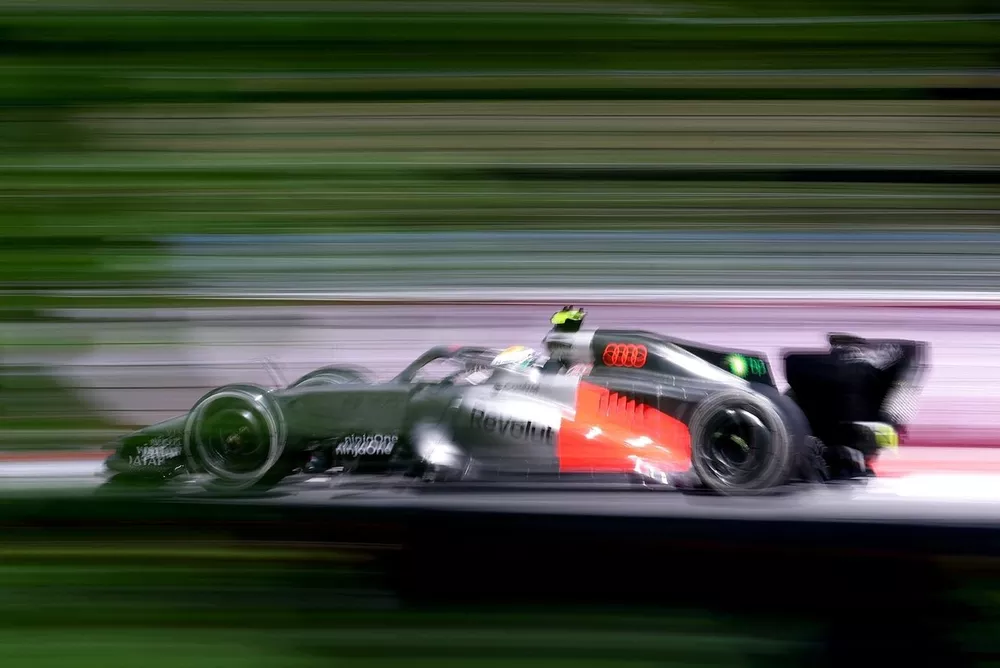
Audi CEO Gernot Dollner has confirmed the German manufacturer would accept a return to V8 engines under Formula 1’s next set of regulations, provided the sport retains a turbocharged architecture and keeps sustainability at the heart of its technical rules. The comments come as F1 and the FIA hold early discussions about the regulatory cycle formally scheduled to begin in 2031, though it could be brought forward if enough manufacturer support exists.
“Yes, why shouldn’t we accept that? I mean, the Nuvolari has a V8 so we don’t have problems with V8 engines,” Dollner said, referencing Audi’s newly launched hybrid supercar. He was quick to add, however, that singling out cylinder count misses the bigger picture. “To just pick one question of a regulation is not really answering the overall question of where do you want to go with the regulation.”
For Dollner, the turbocharger is the element Audi will not compromise on. “We prefer turbo due to the efficiency aspect. That is more important than the number of cylinders,” he said, describing the point as “crystal clear from an Audi perspective.”
Both FIA president Mohammed Ben Sulayem and F1 CEO Stefano Domenicali have spoken favourably about V8 engines running on sustainable fuels paired with a significantly reduced electrical component — a notable shift from the heavily electrified direction that originally attracted Audi to the sport. Domenicali has also argued that the wider automotive industry has moved away from its earlier electrification push, a development Dollner acknowledged Audi has tracked closely.
Dollner framed Audi’s broader position around the principle of sustainability rather than any specific engine configuration. “The most important aspect for Audi is that we keep the idea of being sustainable and having a regulation that has energy efficiency in the focus as a main pillar of Formula 1 regulations,” he said.
Audi entered F1 amid a strong industry-wide drive towards electrification, and the apparent evolution in the sport’s long-term thinking could have created friction with the manufacturer’s original rationale for joining. Dollner’s remarks suggest Audi is willing to adapt, as long as the efficiency credentials that justified its entry into the sport are preserved in whatever framework emerges. The FIA is leading the regulatory process, with manufacturer input forming part of the consultation, and Dollner said he remains “very optimistic that the outcome will be a good one.”
Read also
-
 Formula 1 ·
F1 Academy champion Doriane Pin urges young girls to 'dare to believe' in motorsport dreams
-
 Formula 1 ·
Formula 1 brings full 2026 grid to Hot Wheels Infinite Rush in first-ever F1 gaming crossover
-
Formula 1 ·
F1 Commission cuts 2027 race distances by 15km to manage new power unit fuel demands
-
 Formula 1 ·
Sainz urges Williams karting prodigy Will Green to embrace risk in single-seater step
-
 Formula 1 ·
Steiner predicts Verstappen will go winless in 2026 as Red Bull struggles persist
-
 Formula 1 ·
F1 Academy champion Doriane Pin targets Mercedes race seat within five years