Vettel backs F1 2026 rules to unite sustainability and raw excitement after Monza Ferrari run
Sebastian Vettel, driving Michael Schumacher's 2002 Ferrari V10 at Monza, says Formula 1 has the technology to combine sustainability goals with the visceral racing product fans love, and backs the sport's shift toward synthetic fuels and louder engines.
2 min read
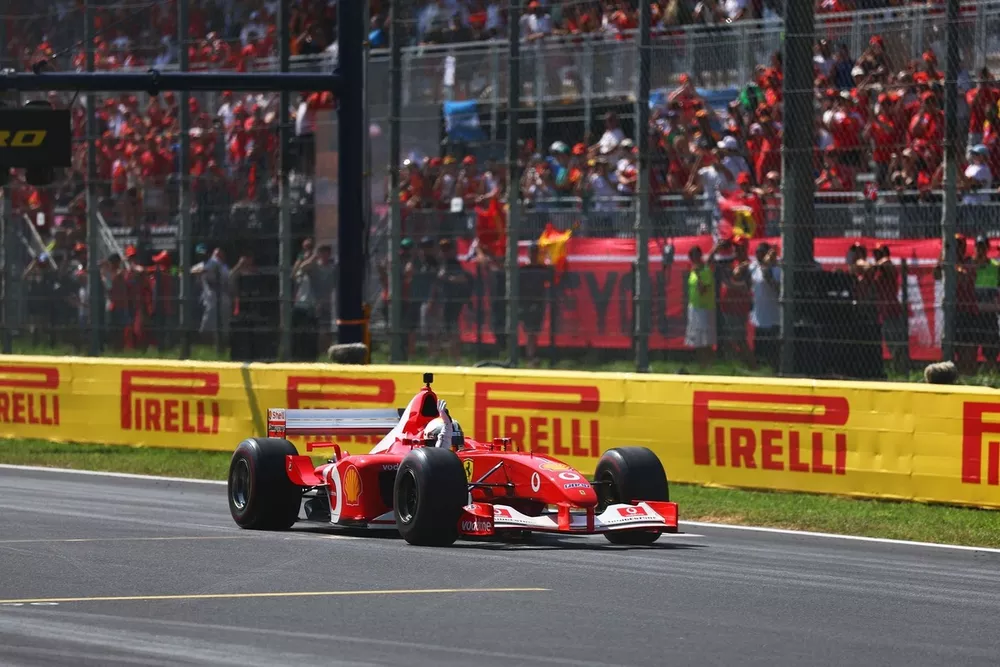
Sebastian Vettel has thrown his support behind Formula 1’s evolving 2026 regulations, arguing the sport no longer has to choose between environmental responsibility and the kind of raw, sensory racing that made him fall in love with it — a view he shared at Monza after driving Michael Schumacher’s screaming 2002 Ferrari F1 car.
The four-time world champion was never an enthusiastic convert to the turbo-hybrid era that arrived in 2014, criticising the muted engine note and the way mechanical complexity blunted the on-track spectacle. His frustration boiled over most memorably in the 2019 Russian Grand Prix, when a Ferrari hybrid failure prompted him to radio his team with a now-legendary demand to “bring back the f***ing V12s”.
Yet Vettel, a committed environmentalist whose green convictions have long sat in apparent tension with his love of old-school motorsport, says advances in technology are dissolving that conflict. “I’m probably not agreeing on everything that we currently have in the regulations from a driving point of view,” he acknowledged, “but looking forward I think that’s where there’s a huge chance to take people on board. One doesn’t have to exclude the other. I think we need to find practices with everything so we are able to combine things that we love.”
Speaking at the Italian Grand Prix, where the backdrop of Schumacher’s thunderous V10 gave his words an obvious resonance, Vettel was equally enthusiastic about F1’s move to advanced sustainable fuels. The switch came after his own retirement from the sport in 2022, but the 39-year-old sees it as a template for what comes next — with current plans pointing toward a return to larger, louder V8 engines by 2030 or 2031.
“I think sustainable fuels are the step forward,” he said. “There’s huge potential not just for Formula 1 but also to inspire other racing series. If you shape the next generation of car, there’s a lot of potential to do so responsibly because some things that may be incredible from a technology point of view might not be transferable to the streets. I think there’s also a responsibility to do that.”
For Vettel, the 2002 Ferrari he piloted at Monza was more than a nostalgic exercise. He framed it as a reminder of what Formula 1 has always stood for — performance, precision, and a relentless pursuit of the state of the art — and suggested the sport’s next chapter can honour that legacy while pointing toward a cleaner future. “The cars today do the same,” he said of the modern grid. “It’s about performance, precision, discipline, hard work but also responsibility and caring about the future, which these cars are trying to do.”
Read also
-
 Formula 1 ·
Steiner warns Madrid must fix Madring layout after processional 2026 Spanish GP
-
 Formula 1 ·
Ex-Ferrari engineer Smedley calls for augmented steward group to end post-race verdicts
-
 Formula 1 ·
Coulthard demands faster FIA safety car calls after Norris loses Spanish GP win
-
 Formula 1 ·
Coulthard praises Russell for admitting Antonelli is outperforming him as title slips away
-
 Formula 1 ·
Racing Bulls rookie Lindblad nearly flips Guinness-record Fiat Panda in off-season YouTube stunt
-
 Formula 1 ·
Rosberg brands Williams 2026 campaign 'a shocker' as Vowles faces uphill recovery