Mercedes' secret weekly codes helped Antonelli nail his race-winning VSC pitstop in Madrid
Mercedes trackside engineering director Andrew Shovlin has revealed the team uses rotating secret codes — changed every race weekend — to prime drivers for potential safety car calls, a system that proved decisive in Kimi Antonelli's Spanish Grand Prix victory.
2 min read
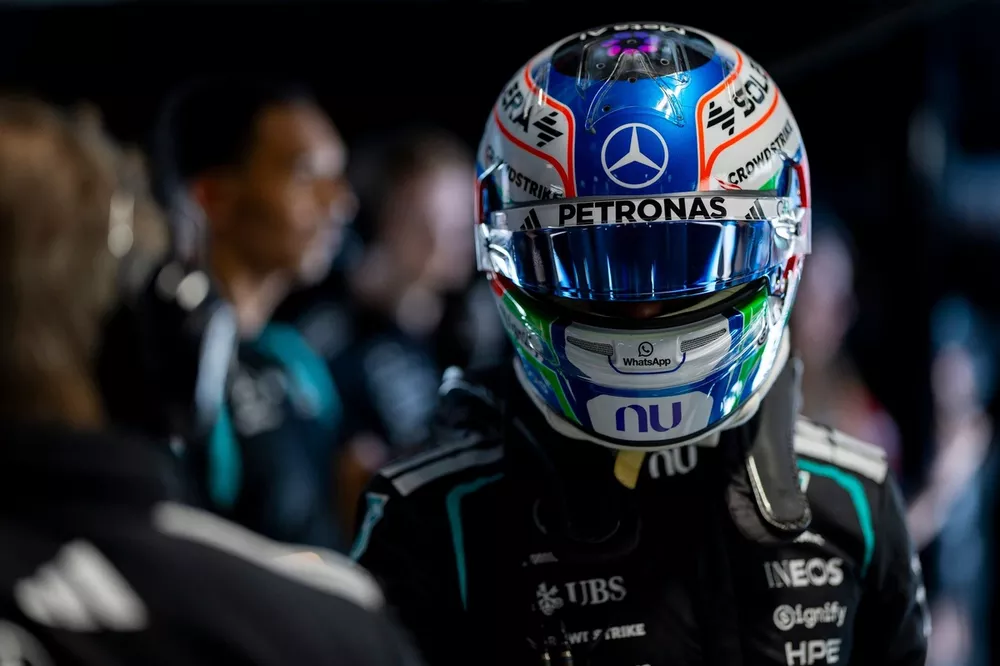
Kimi Antonelli’s victory at the Spanish Grand Prix hinged on a split-second pitstop triggered by a virtual safety car, and Mercedes has now revealed the coded communication system that helped make it possible.
Trackside engineering director Andrew Shovlin explained on the NU Silver Arrows Radio Show podcast that Mercedes uses secret codes — rotated every single race weekend — to signal to its drivers whether a safety car pitstop might be worth targeting during a race, without alerting rival teams monitoring radio traffic.
“We will use secret codes to give them an idea of whether they might want to come in on a safety car during the race. But we try not to let all the other teams know what those codes are. So, we change them every single week,” Shovlin said.
The sequence of events that decided the race began when Lance Stroll’s Aston Martin stopped, triggering yellow flags at Turns 18 and 20. Race engineer Peter Bonnington — known as Bono — immediately warned Antonelli: “Yellow, yellow, 19-20,” followed by “So, a big lift” and then “You are in safety car window.” Moments later, with the VSC deployed, came the call to pit.
Crucially, Antonelli did more than simply lift in the yellow-flag zone. He also delayed getting back on the throttle in the subsequent green-flag section, costing himself more time than the cars around him — including race leader Lando Norris and Max Verstappen directly behind — but buying a vital extra second before the pit entry.
“Kimi actually backed off a bit and bought himself another second, which was probably… He might have got in without it. It certainly made it possible,” Shovlin said. “And if you watch the onboard from Kimi’s car, you’ll see that Kimi getting in was not an easy thing. You’ll see that as he was pulling up in the pit box, the tyres were arriving as he was stopping. So, it was a difficult stop to execute in that time frame.”
Antonelli himself confirmed after the race that Bonnington had warned him a VSC might be coming, prompting the deliberate slowdown. It remains unclear precisely which of Bonnington’s messages carried the coded instruction, given only a handful of exchanges took place between Stroll stopping and the Mercedes driver committing to the pitlane.
The episode illustrates how modern Formula 1 race strategy operates on multiple layers simultaneously — public radio calls, coded signals, and real-time driver instinct — with the margin between a race-winning stop and a missed opportunity measured in fractions of a second.
Read also
-
 Formula 1 ·
Vowles admits Williams upgrades won't rescue team from 2026 F1 struggles
-
 Formula 1 ·
Rosberg warns Antonelli could grow 'panicked' if McLaren and Ferrari close the gap
-
 Formula 1 ·
Class-action lawsuit targets Cadillac F1 backer Mark Walter over alleged $17bn fraud scheme
-
 Formula 1 ·
Vowles hails Madrid's debut F1 race as 'one to watch' despite overtaking concerns
-
 Formula 1 ·
Mercedes shifts focus to 2027 as 145-point F1 lead gives Wolff room to plan ahead
-
 Formula 1 ·
Rosberg calls for VSC pitlane overhaul after Norris loses Spanish GP victory