Hockenheim in F1 return talks but faces 'virtually zero' public funding
Hockenheim's managing directors confirm the circuit is in discussions with Formula 1 about returning to the calendar, but warn the project is 'largely theoretical' given an almost complete absence of government financial support.
2 min read
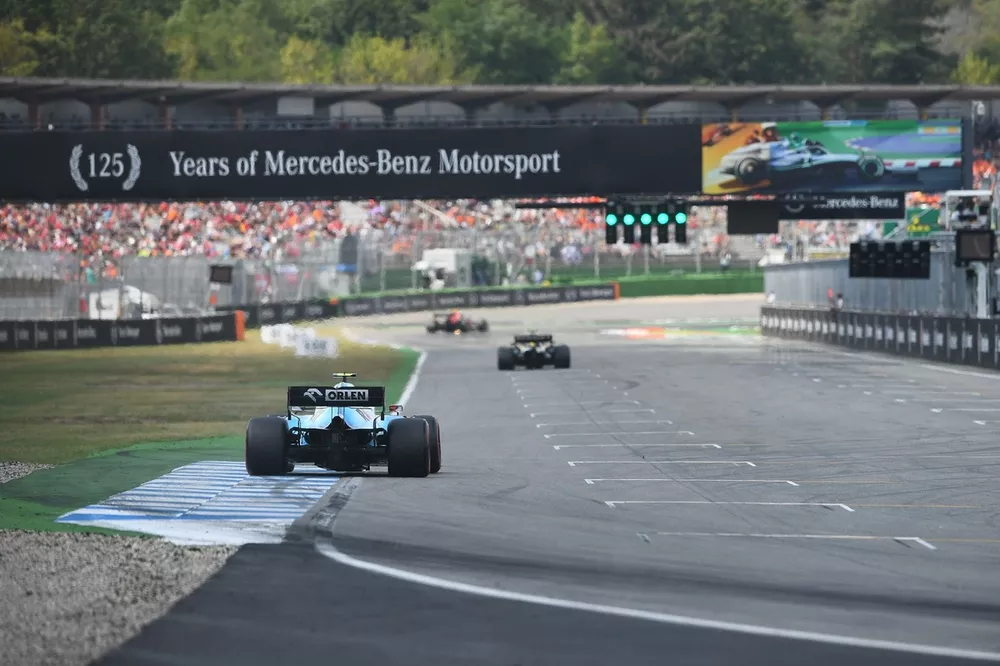
Hockenheim is engaged in talks with Formula 1 over a potential return to the German Grand Prix calendar, but the circuit’s own managing directors describe the prospect as “largely theoretical” — chiefly because public funding is, in their words, “virtually zero”.
Joern Teske and Jochen Nerpel, the Hockenheimring’s co-managing directors, addressed the situation publicly as the Baden-Württemberg circuit unveiled Motorworld, a new mixed-use development combining motorsport facilities, retail, hotels, workshops and event spaces on site.
“Formula 1 is naturally watching very closely what is happening here at the Hockenheimring,” Teske said. “We are in discussions. Formula 1’s priority, of course, is that the overall conditions at the Hockenheimring are right.” He added that F1 CEO Stefano Domenicali was among those impressed by images of the new Motorworld building, though he acknowledged the facility alone is not sufficient to secure a race.
The circuit first hosted the German Grand Prix in 1970 and was a fixture on the F1 calendar from 1977 to 2006, before shifting to biannual appearances — initially alternating with the Nürburgring — until 2018. A final race was staged in 2019 with financial backing from Mercedes, but deteriorating economics made any continuation unfeasible.
Nerpel outlined the practical requirements for hosting F1 again: temporary grandstands to lift capacity from just under 60,000 to close to 100,000, and an expanded pit building capable of accommodating all 11 teams. The contrast with state-backed venues elsewhere in the world was not lost on him.
“We often sit here and say, ‘Have you seen that pit building in Hungary?’” Nerpel said. “Something like that gets built almost overnight — those buildings went up in something like six to nine months. These are two completely different approaches. When a government or a country shows an interest and says, ‘This matters to us’ — look at Rwanda, for example, which is now part of the discussion — we sometimes think it is extraordinary how little standing Formula 1 has in Germany, a country famous for its automotive industry, and how little support there is for it.”
F1 currently runs a 24-round calendar, with Rwanda confirmed as a future addition in the early 2030s. Hockenheim remains in the conversation, but without meaningful state investment, closing the gap between discussion and a signed contract appears a considerable challenge.
Read also
-
 Formula 1 ·
Cowboy hats, Godzilla and denim: F1 teams go all-in on Texas style for the 2026 US Grand Prix
-
 Formula 1 ·
Piastri warns McLaren's MCL40 problems will not be solved before season ends
-
 Formula 1 ·
FIA closes F1 cost cap loophole by forcing strict separation of team staff
-
 Formula 1 ·
Leclerc admits Ferrari's raw pace lags behind rivals ahead of Austin upgrade
-
 Formula 1 ·
Norris vows to make better decisions after McLaren hold fresh talks over Piastri clash
-
 Formula 1 ·
Horner admits he pressured Masi to restart the 2021 Abu Dhabi GP that handed Verstappen the title
 Ghana U17 W
