Erasmus and Peyper push back on Springboks' slow-game accusations ahead of All Blacks series
Springboks head coach Rassie Erasmus and technical consultant Jaco Peyper have defended South Africa's tempo of play, insisting they have received zero negative referee feedback about slowing the game in 2026 and pointing to the 30-second set-piece law as their guide.
2 min read
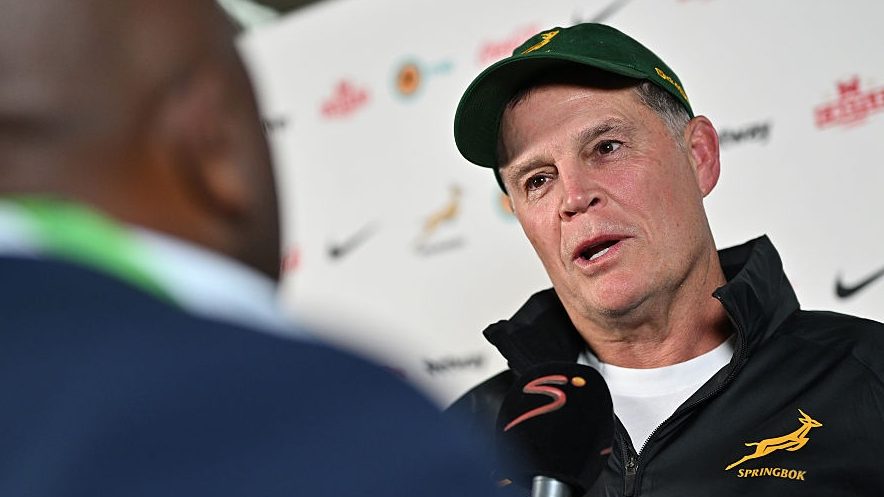
Rassie Erasmus and Jaco Peyper have jointly rejected claims that the Springboks deliberately slow the game down, with the pair addressing the narrative directly ahead of South Africa’s series against the All Blacks.
Peyper, the former referee who now serves as a technical consultant to the Springboks, said the team has not received a single piece of negative feedback from match officials about game tempo across their five Tests in 2026. He pointed to a formal agreement struck at the start of the year between referees and coaching staff — known as the “Shape of the Game” meeting — as the framework within which South Africa operates.
“Over time, the five games I’ve played, we’ve not had one feedback that we slow down the game,” Peyper said. “What we expect is to play in terms of those agreements with the play between referees and coaches.”
The specific law Peyper cited gives teams 30 seconds from the moment a referee places his foot down to mark the spot — not from the whistle — to form a scrum or lineout. Crucially, he stressed that the clock starts at the mark, not when the ball must be in.
“The law is very clear: 30 seconds from the moment the referee puts his foot down to make a mark, whether it’s scrum or lineout, not from the whistle, from when the foot’s put down, there’s 30 seconds to form, not to get the ball in,” Peyper said.
Erasmus elaborated on what teams are permitted to do in the time before that mark is given, defending the Springboks’ practice of huddling before lineouts — a habit that has drawn scrutiny from critics.
“What you do up until that lineout, you can pray if you want to,” Erasmus said. “You can huddle. There’s nothing in the law that say you can’t huddle. We’ve got 11 languages which we have to make sure that everybody understands the lineout call.”
Peyper also pushed back on the broader accusation by suggesting the slow-game narrative tends to emerge at altitude venues, and that it is typically the team under the most pressure that seeks to reduce tempo — not the home side.
“I’ve refereed many Super Rugby games here where teams that travel slow the game down,” he said. “You can also slow the game down by continuously infringing at the breakdown or at the maul and break the game tempo there.”
He added that with experienced referees appointed to the matches and clear guidelines in place, the onus would fall on whichever team finds itself under pressure to manage the pace of play.
The comments set up a pointed tactical subplot to the Springboks-All Blacks series, with South Africa’s set-piece-heavy approach set to be tested against New Zealand’s preference for high-tempo, continuity-based rugby.
Read also
-
 Rugby ·
Brumbies hand rookie Kye Oates two-year deal after ankle surgery ends debut season
-
 Rugby ·
Lio-Willie earns All Blacks recall as injury crisis forces Rennie's hand for Nations Championship
-
 Rugby ·
Mo'unga ruled out of Scotland Test as All Blacks manage injury concerns on November tour
-
 Rugby ·
Rennie signals McKenzie-Barrett axis at 10-15 for All Blacks' Nations Championship tour
-
 Rugby ·
World Rugby confirms SVNS 3 joins top-tier Dubai Sevens for first time in November
-
 Rugby ·
Black Ferns lose Turner and Lolohea to injury ahead of series-clinching France decider