Bellingham's Goal Marred by Trajectory Anomaly That FIFA Denies Despite 3D Modeling
Jude Bellingham's equalizer for England in the 45th+2 minute against Norway in the 2026 World Cup quarter-final is at the center of a major controversy: the ball allegedly struck the Spidercam cable, which FIFA denies but BBC's 3D reconstruction appears to contradict.
1 min read
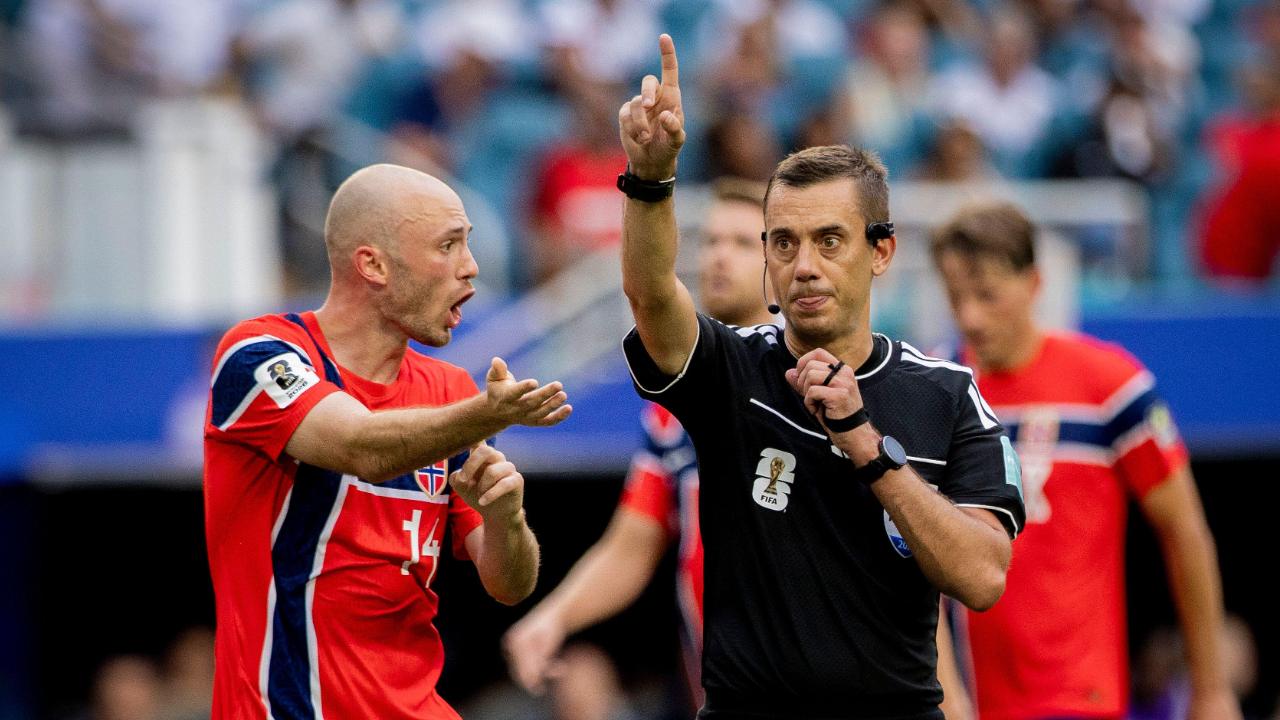
Jude Bellingham’s equalizer in the 45th+2 minute of the Norway-England quarter-final, Saturday in Miami, is at the heart of a major controversy at this 2026 World Cup. The Norwegians claim the ball struck the Spidercam’s metal cable before being recovered by the English, which should have resulted in a stoppage according to the laws of football.
The disputed action began with a long clearance from goalkeeper Ørjan Nyland. In mid-flight, the ball’s trajectory appeared to break sharply and fall vertically, landing directly in front of the Norwegian bench. Ståle Solbakken’s players immediately pressed French referee Clément Turpin. According to IFAB rules, any contact between the ball and an element suspended above the pitch requires immediate stoppage of play and a drop-ball restart. The Norwegian manager summed up his team’s frustration to the press: “The ball fell straight from the sky in front of our bench. It changed direction. Everyone saw what happened.”
Faced with the scale of the controversy on social media, FIFA issued a statement relying on the smart ball technology used during this World Cup. The international body claimed that the sensor embedded in the ball “showed no spike in the ball’s heartbeat when it was in the air,” concluding there is “no evidence that the ball touched the aerial cable or that its trajectory was altered.”
But the three-dimensional reconstruction published by the BBC, generated from FIFA’s official tracking data, directly contradicts this denial. The virtual model reveals a flagrant anomaly in the ball’s trajectory — a sudden jolt — at the precise location where the Spidercam cable was positioned. The 3D model’s kinematics thus supports what the Norwegian players and staff had denounced immediately, reopening debate over the reliability of the embedded sensor and referee Turpin’s decision to validate the goal.
England, which was trailing 1-0 before this equalizer, ultimately continued its run in the competition. Norway, meanwhile, still awaits a coherent explanation from the international authorities.
Read also
-
 Football ·
Yamal scores twice as World Cup champions Spain extend unbeaten run to 40 games
-
 Football ·
Barcelona summons Florentino Pérez to court over defamatory Negreira comments
-
 Football ·
Gordon and Kane break Czech Republic's resistance with ten men, England climbs
-
 Football ·
Ivory Coast Snatches Victory in Somalia in Extra Time
-
 Football ·
Keane says City players should put their medals 'in the bin' after guilty verdict
-
 Football ·
Alexander-Arnold's assist masterclass for England may not be enough to keep his starting place
 Mauritius