Verstappen and Hadjar warn Mexico Grand Prix will be 'slippery as hell' with active aero
Max Verstappen and Isack Hadjar have flagged an unusually demanding weekend at the Autodromo Hermanos Rodriguez, warning that active aerodynamics will leave drivers with less downforce than ever at altitude — and precious little grip to compensate.
2 min read

Max Verstappen and Isack Hadjar arrived at Mexico City’s Autodromo Hermanos Rodriguez on Thursday predicting one of the most physically demanding weekends of the Formula 1 season, with active aerodynamics stripping away the traditional tools teams use to manage the circuit’s notorious high-altitude grip deficit.
Situated 2,286 metres above sea level, the Mexico City track has always forced teams to run near-Monaco levels of wing angle to compensate for the thin air’s effect on downforce. At altitude, even that aggressive setup typically yields only Monza-equivalent downforce levels. This year, the introduction of active aerodynamics removes the flexibility to lean further on wing choice — meaning cars will carry less downforce overall and, in Verstappen’s words, slide around considerably more.
“Here is a lot less grip,” Verstappen said. “With the altitude, we normally have the wings to compensate a little bit for that, but now you basically just run one wing. So there will be a lot less downforce on the car, which I think will already be quite challenging. That probably puts even more emphasis on low-speed performance.”
That emphasis is a mild concern for Red Bull. Verstappen acknowledged in Austin that the RB22 is a reasonable all-rounder but does not excel in either high-speed or low-speed corners. It is worth noting, however, that he won in Singapore — a circuit dominated by slow-speed sections — and qualified on the front row in Monaco before the car received its major upgrade package.
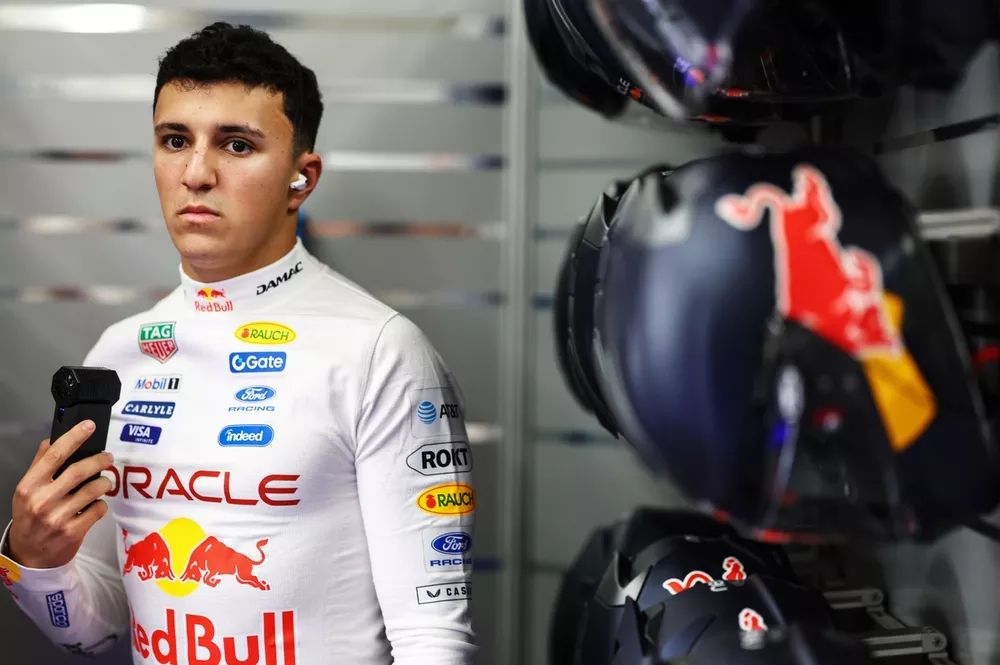
Team-mate Hadjar, making his first Mexico City start as a Formula 1 race driver, was even more vivid in his assessment. The Frenchman said the resurfaced circuit, despite its supposedly improved asphalt, would do little to soften the challenge.
“I’m just thinking how extreme it’s going to be to drive these cars,” Hadjar said. “Last year, I already felt like I was sliding around a lot with the Monaco rear wing. Now, it’s kind of the same downforce level throughout the year and you’re going to a track like this. It’s going to feel slippery as hell.”
Turbo lag is the other major talking point heading into the weekend. With the MGU-H removed from the 2026 power unit regulations, the hybrid system can no longer spool the turbocharger at altitude — a function it previously performed to reduce the lag drivers feel when applying throttle out of slow corners. Engine manufacturers and drivers alike will need to manage that characteristic carefully across a lap that features several tight, low-speed sections where traction is already at a premium.
Read also
-
 Formula 1 ·
Steiner warns Mercedes will replace Russell if struggles persist into 2027
-
 Formula 1 ·
Leclerc leads rookie-filled FP1 in Mexico as Antonelli and Vesti complete top three
-
 Formula 1 ·
Ill Perez misses Mexico GP fan forum but targets practice at his home race
-
 Formula 1 ·
Perez signs Cadillac deal to 2029 but rules himself out of 2027 team-mate decision
-
 Formula 1 ·
Hadjar walks back Austin criticism of Red Bull but stands by strategy concerns
-
 Formula 1 ·
Piastri admits McLaren's MCL40 demands near-perfect laps as team chases upgrade answers