Piastri reveals McLaren's sim shows higher top speed in Hungary than at Monza in 2026
Oscar Piastri has disclosed that McLaren's simulator data shows its 2026 car reaching greater peak speeds at Hungary's twisty layout than at Monza, exposing a fundamental energy-management flaw in the new formula at F1's traditional fastest circuit.
2 min read
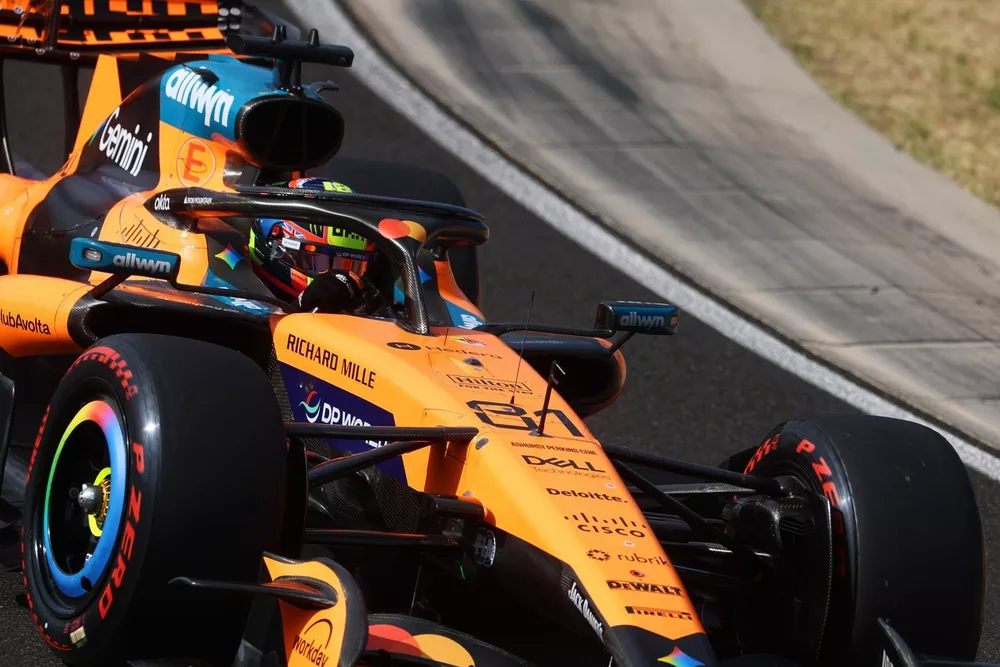
Oscar Piastri has revealed that McLaren’s pre-weekend simulator work for the 2026 Italian Grand Prix showed the team’s car hitting lower top speeds on Monza’s famous front straight than it was achieving in Hungary — a circuit defined by slow, tight corners rather than long, flat-out blasts.
The disclosure underlines a structural problem with the 2026 power-unit regulations, where close to 50% of a car’s output comes from its electrical system. At Monza, drivers spend roughly 80% of each lap at full throttle, draining electrical reserves rapidly while offering almost no opportunity to recharge through braking or cornering. The FIA has capped energy harvesting at 4 megajoules per lap specifically to limit the amount of lift-and-coast and so-called “super clipping” — the phenomenon where a car’s hybrid system cuts power at the end of a straight — but the trade-off is a meaningful reduction in outright peak speed.
“At a circuit like this, you’ve got a problem no matter which direction you go,” Piastri said. “If the harvest limit was higher, we would be super clipping everywhere and probably losing 30 or 40km/h at the end of each straight. But the drop to the harvest limit, which means the super clipping is a normal-ish amount, or a reasonable amount, it’s still there.”
The Australian acknowledged the paradox directly: giving the cars more energy to spend on the straights is pointless if Monza’s layout provides nowhere to harvest it in the first place. “The actual top speed is quite low,” he added. “In our sim running, I think we were actually quicker on the front straight in Hungary than we were here, which doesn’t make a whole lot of sense, but it’s more that we just don’t have the energy to spend.”
McLaren has fitted its low-drag ‘H-wing’ configuration this weekend in an attempt to extract whatever straight-line performance is available, but Piastri suggested the aerodynamic choice is almost secondary to the energy constraint.
Despite the limitations, the McLaren driver indicated he broadly supports the regulatory approach. “For me, I think this is the correct direction to go in and have a sensible amount of super clipping,” he said, framing the current harvest cap as the lesser of two evils compared with the alternative of cars visibly losing large chunks of speed at the end of every straight.
Energy management has been a recurring flashpoint across the 2026 season, with drivers and fans frustrated by the visible lift-and-coast sequences that have characterised racing since the new formula was introduced. Monza, long marketed as the pinnacle of raw speed in Formula 1, now appears set to provide the starkest illustration yet of how profoundly the new power-unit architecture has reshaped the sport’s performance landscape.
Read also
-
 Formula 1 ·
Mercedes mocks championship leader Antonelli after he reverses into a fence in Austin
-
 Formula 1 ·
Colapinto brushes off Clarkson's Argentinian grid-penalty jibe after Austin retirement
-
 Formula 1 ·
Montoya questions Russell's COTA penalty, insisting Mercedes driver gained no advantage
-
 Formula 1 ·
Verstappen takes sixth straight podium in Austin but slams Red Bull's starts, strategy and radio failures
-
 Formula 1 ·
Alonso blasts 'very low quality' backmarkers after Albon clash wrecks his United States GP
-
 Formula 1 ·
Alonso blasts bottom-third drivers after Albon contact destroys Aston Martin floor in Austin