FIFA tender documents suggest hydration breaks set to stay for 2030 World Cup
Tender documents for the 2030 World Cup TV rights include a provision for broadcasters to sell adverts during hydration breaks, suggesting FIFA is likely to retain the controversial three-minute stoppages introduced at the 2026 tournament in North America.
2 min read
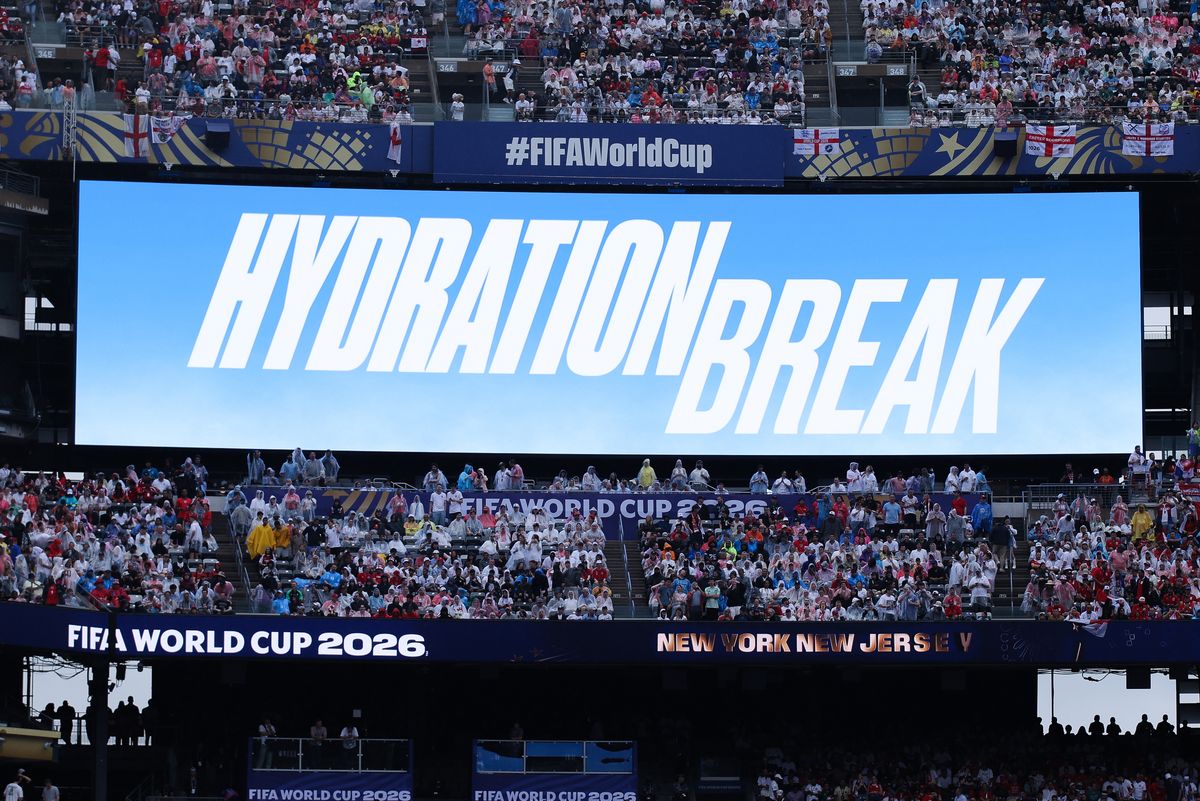
FIFA’s controversial hydration breaks appear set to survive into the 2030 World Cup, with tender documents for the tournament’s television rights including a provision for broadcasters to sell advertising during the stoppages — a strong signal that the governing body has not ruled out keeping them.
The three-minute breaks in each half were introduced for the first time at the 2026 World Cup across Canada, the United States and Mexico, splitting traditional 45-minute halves into quarters across all 104 matches. FIFA’s stated rationale was player welfare in the scorching temperatures of many host venues, though the breaks also created additional advertising inventory for rights holders.
According to The Guardian, FIFA tender documents for the 2030 tournament — hosted across Spain, Portugal and Morocco — contain a clause allowing broadcasters to sell adverts during hydration breaks. FIFA have said no final decision has been taken and that the documents are designed to cover all eventualities at this stage.
The breaks proved deeply unpopular with television audiences, who grew frustrated by the interruptions, particularly when matches were played in milder conditions. Coaches, however, broadly welcomed them as an opportunity to address their players and adjust tactics mid-half.
The commercial upside for broadcasters was significant. Fox Sports reportedly generated between $2 million and $9 million in additional advertising revenue per game as a result of the breaks, with figures from Guideline suggesting the US broadcaster made $835 million during the tournament — almost double the $485 million rights fee it paid to FIFA.
FIFA president Gianni Infantino offered a measured defence of the breaks during the tournament. “Broadcasters maybe generate more, but for us, we make zero additional revenues,” he said. “Maybe the coach can reassess certain situations, correct certain mistakes. The players get a little rest and come back in full speed. Well, is that bad necessarily? Maybe it’s good.”
Infantino also pointed to the intensity of play as a potential benefit. “We’ve never seen 90 minutes in a tournament like this played in such intensity. Until the last second of the match, players attack. And maybe, maybe not, but maybe it’s also a bit thanks to this little break.”
UEFA has opted against implementing mandatory hydration breaks at Euro 2028, which is being hosted across the UK and Ireland, suggesting the two governing bodies remain divided on the issue. Whether FIFA’s commercial interests ultimately tip the balance for 2030 is a question the tender documents appear to be quietly answering.
Read also
-
 Football ·
Real Madrid extends Arda Güler through 2032, valued at €100m
-
 Football ·
Arsenal face unpopular contract calls as Odegaard and Havertz renewals stall
-
 Football ·
Nico Paz shines with brace in Argentina's first match without Messi
-
 Football ·
Sealand's national football team returns in 2027 with e-citizenship open to anyone for £7.99
-
 Football ·
Manchester United's Carrington floodlight plans face objection over bat habitat concerns
-
 Football ·
Hemdani sacked after Algeria's 0-3 rout against Togo
 Switzerland U17
