FIA investigates Red Bull and Ferrari rotating wings after Verstappen's two crashes
The FIA has contacted both Red Bull and Ferrari seeking additional information on their rotating 'Macarena' rear wings, following two separate failures on Max Verstappen's car at Spielberg and Silverstone that the driver called "super dangerous".
2 min read
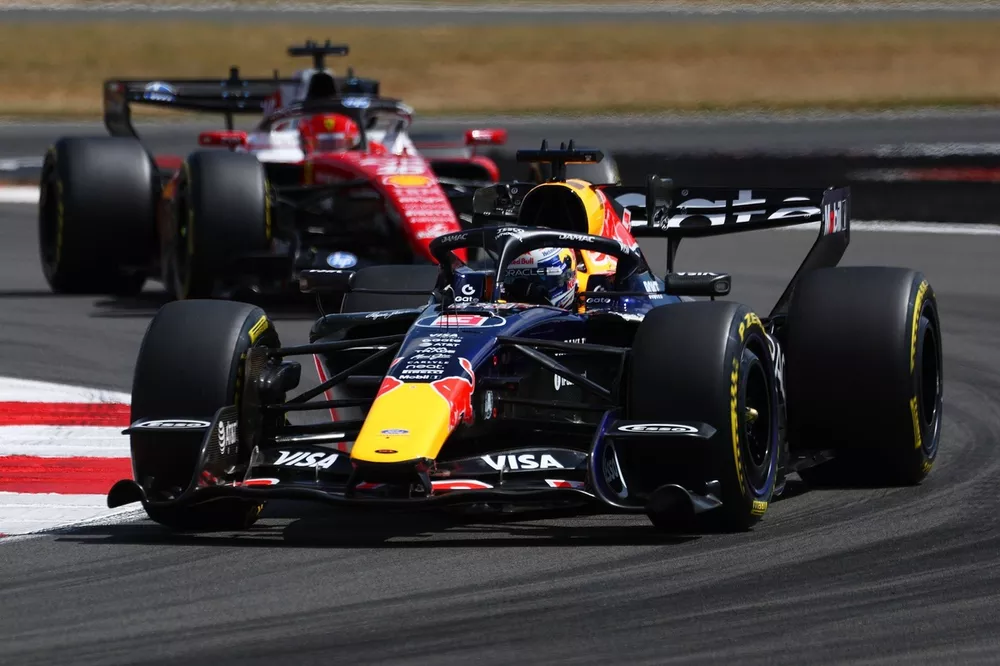
The FIA has opened an inquiry into the rotating rear wings used by Red Bull and Ferrari this season, requesting further information from both teams after Max Verstappen suffered two separate wing-related crashes at Spielberg and Silverstone.
Motorsport.com has learned that the governing body contacted the teams regarding their so-called ‘Macarena wings’ — a nickname coined after the design’s introduction at the Miami Grand Prix. The FIA’s primary concern is ensuring both teams are fully compliant with all applicable safety requirements while the system is in operation.
Ferrari was the first constructor to unveil a rotating rear wing concept, debuting it during pre-season testing in Bahrain before ultimately choosing Miami as its race introduction. Red Bull followed with its own version in Florida, though technical director Pierre Wache was clear that the design had been developed independently, with work beginning as far back as November 2025. Notably, Red Bull’s wing rotates in the opposite direction to Ferrari’s and creates a more aggressive aerodynamic opening, generating greater drag reduction on the straights.
While Ferrari has reported no technical issues with its version, Red Bull has experienced two failures on Verstappen’s car. The team has confirmed that the incidents at Spielberg and Silverstone were caused by two distinct problems. Verstappen, speaking after his Silverstone crash last Sunday, described the situation as “super dangerous”.
Red Bull team principal Laurent Mekies had already pledged a thorough internal investigation, saying the squad would leave “no stone unturned” in identifying the root causes.
Among the safety requirements the FIA is examining is the regulation mandating a maximum transition time of 400 milliseconds for the rear wing to return to its closed position. The technical regulations specify that any adjustment of the rear wing flap must be controlled by the FIA Standard ECU and must complete the transition between its two fixed positions within that 400ms window, measured from the moment the command is issued. However, as the FIA is aware, meeting that time limit does not automatically guarantee that airflow has fully reattached to the wing surface — a distinction that may prove central to the investigation.
At this stage, no formal sanctions or design bans have been announced. The FIA’s inquiry appears focused on gathering data and clarifying compliance before determining whether additional checks or revised requirements are necessary.
Read also
-
 Formula 1 ·
Rosberg brands Williams 2026 campaign 'a shocker' as Vowles faces uphill recovery
-
 Formula 1 ·
Ferrari unveils all-black race suit for Leclerc ahead of Singapore Grand Prix
-
 Formula 1 ·
Szafnauer backs Wolff's Antonelli gamble as teenager leads standings by 81 points
-
 Formula 1 ·
Smedley credits Bonnington as the force steadying Antonelli's 81-point F1 title lead
-
 Formula 1 ·
Coulthard calls Antonelli a 'phenomenon' and predicts 2026 title as 81-point lead grows
-
 Formula 1 ·
Williams concedes 2026 season is a write-off as resources shift to 2027
 Brazil U20 W