FIA filings reveal the quiet aero fix that underpinned Verstappen's Las Vegas GP win
A repositioned front wing dive-plane, confirmed in Red Bull's FIA submission, gave Max Verstappen the aerodynamic stability he needed to win the Las Vegas Grand Prix — a detail that went largely unnoticed amid the race's battery-deployment drama.
2 min read
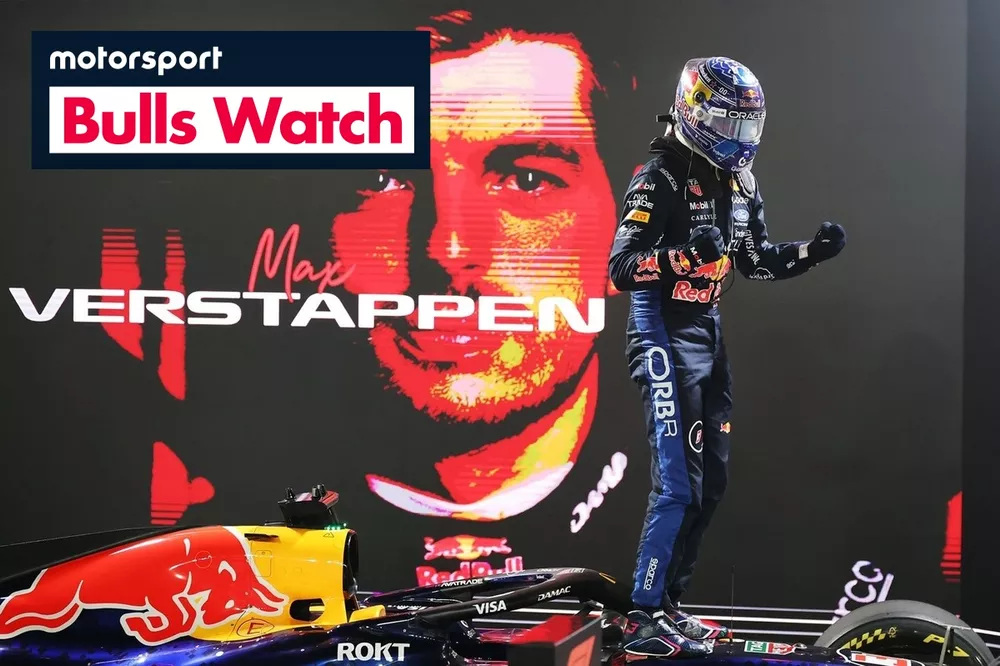
A single, carefully repositioned front wing dive-plane formed the aerodynamic backbone of Max Verstappen’s Las Vegas Grand Prix victory, according to official FIA Car Presentation Submissions filed on 19 November.
While the race itself unfolded as an intense battle over battery deployment, Red Bull’s engineers had already done the quiet work in the garage. FIA Document 9 records just one Red Bull update for Las Vegas, classified under Performance – Local Load: a lowered, shortened dive-plane on the front wing endplate. “In order to better protect the flow stability of the front wing endplate footplate as well as surfaces downstream, the dive-plane has been lowered and reduced in chord length,” Red Bull wrote in its submission.
The change may look minor on paper, but the dive-plane carries significant aerodynamic responsibility. Beyond contributing front-axle downforce, it sheds tip vortices that push turbulent front-tyre wake outward, and it separates airflow travelling over the top of the wheel from air moving around its side — feeding cleaner, more attached flow down the car’s flanks for the remainder of its journey to the floor and diffuser.
As Formula1.com Tech Weekly contributors Mark Hughes and Giorgio Piola noted, the revised winglet also stabilises airflow during the abrupt transition between straight-line and cornering modes when the main front wing flaps rotate — a characteristic that will become increasingly relevant under 2026’s active-aerodynamics regulations.
Red Bull had last updated its front wing endplates during September’s major Baku upgrade package. For Las Vegas, engineers dropped the dive-plane lower on the vertical endplate and trimmed its chord into a compact profile closely resembling the solution already in use at sister team Racing Bulls.
The Las Vegas tweak did not arrive in isolation. In Baku, Red Bull had introduced taller, slimmer sidepods alongside a revised floor and diffuser. Four weeks later in Mexico City — FIA Document 12, dated 30 October — engineers modified the sidepod-to-floor split line, grafting the curved lower bodywork from the pre-Baku specification onto the taller Baku upper pod. The goal was to close off the floor-edge channel and recover local aerodynamic load beneath the radiator inlet.
The contrast with Red Bull’s rivals in Las Vegas is striking. Mercedes focused on drag reduction, stripping rear wing winglets, trimming mirror stays, and narrowing its engine-cover exit. Ferrari optimised its front floorboard for the high-speed demands of the Strip. Red Bull, by contrast, invested its single update in flow stability — a bet that, combined with Verstappen’s race management, proved decisive across 50 slipstream-heavy laps.
Read also
-
 Formula 1 ·
Verstappen admits he would 'rather stay at home' for F1's Middle East finale amid regional conflict
-
 Formula 1 ·
Williams docked wind tunnel time as Alpine fined for separate 2025 cost cap breaches
-
 Formula 1 ·
Brown rules out McLaren engine programme as Mercedes partnership stays firm for 2030
-
 Formula 1 ·
Alonso admits Honda power unit leaves Aston Martin unable to compete in Formula 1
-
 Formula 1 ·
Norris questions Las Vegas's 352-overtake record, calling many passes battery-assisted illusions
-
 Formula 1 ·
Unaired radio reveals Red Bull urged Verstappen to surrender the lead with one lap left in Las Vegas

 New Zealand U17
