Clarke reveals how Springboks outfoxed All Blacks in the aerial battle during Rugby's Greatest Rivalry
Caleb Clarke has opened up on New Zealand's persistent high-ball struggles, explaining how South Africa's chasers consistently positioned themselves between the winger and the ball to disrupt Dave Rennie's revised aerial strategy across the series.
2 min read
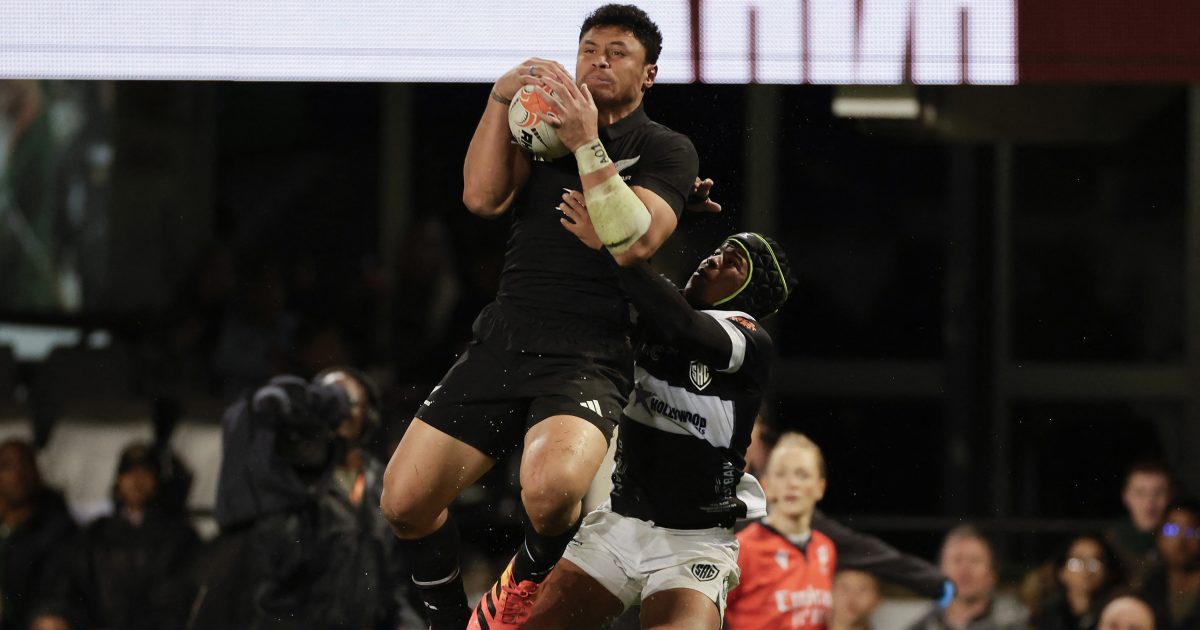
Caleb Clarke has acknowledged the All Blacks’ ongoing difficulties under the high ball and detailed how the Springboks systematically dismantled New Zealand’s revised aerial strategy during Rugby’s Greatest Rivalry.
Dave Rennie’s side had attempted to implement a new approach — having wingers retreat and take catches facing their own dead-ball line — but South Africa’s chasers repeatedly raced ahead of the play to insert themselves between the receiver and the ball, giving the Springboks a stronger chance of retaining the contestable kick.
“Yeah, it’s a tough one, honestly,” Clarke said. “And I’ll tell you, with these new rules, it’s been slow for us to adjust, especially when it comes to that one-on-one competing in the air. It’s literally just what we’re talking about all the time around, just catching it cleanly.”
Clarke, widely regarded as one of New Zealand’s most accomplished aerial threats, described the trial-and-error process the All Blacks have been working through. “We tried different things. We tried hitting back and trying to catch it on the run, trying to come forward and catching it as well. But credit to the Springboks who just really put pressure on the catcher, and everyone else was picking up those scraps.”
The winger drew on an unlikely reference point to illustrate the technical demands of high-ball work — a training stint with AFL club the Sydney Swans. “I remember when I went over with the Swans, they were all wondering why I kept catching like this,” Clarke recalled. “The fundamentals of jumping and timing your jump, catching at the max height of your jump is what they were really trying to teach me, and what I try to bring back to rugby. So, yeah, we were practising it in the All Blacks environment.”
Clarke was keen to stress that the aerial deficiencies are not being ignored within the squad, even if live training carries its own complications. “It’s a touch and go. We do go live against each other, but at the same time, we want to protect each other as well. We’re competing for these spots, and also we want to make sure the boys that get out there on the night are in good health.”
The struggles have persisted since Rennie took charge at the start of the 2026 international season, compounding issues that were already evident during 2025. With Rassie Erasmus’ Springboks having found a reliable counter to New Zealand’s adjusted approach, the All Blacks will need to find a further evolution in their aerial game before the rivalry resumes.
Read also
-
 Rugby ·
Caleb Clarke targets Super Rugby return after ruptured shoulder tendon ends South Africa tour
-
 Rugby ·
USA Women's Eagles overturn 12-point deficit to stun Ireland 40-36 in Dublin
-
 Rugby ·
USA stun Ireland with second-half maul blitz to win WXV clash in Dublin
-
 Rugby ·
Former Fiji captain Nayacalevu reinvents himself as a No.8 on debut for fifth-tier RO Grasse
-
 Rugby ·
Munster's fly-half crisis forces province to hand debut to 20-year-old and recall discarded veteran
-
 Rugby ·
Japan climb back into World Rugby top 10 after edging Fiji in Pacific Nations Cup final

 New Caledonia